The Promise of LLM-Driven Scrapers
When I first saw different “create scrapers with LLMs,” tools and frameworks popping up in the market, I was impressed. These tools seem to let you skip most of the coding and simply describe what you need—prices from an e-commerce site, headlines from news pages, whatever—and they generate a scraper for you. It’s intuitive, fast, and exciting.
But once I tried using it to go beyond the proverbial hello world projects, I realized that many of these tools aren’t ready to handle the actual challenges of web data collection projects that are meant to scale.
This setup is ideal for small-scale projects or non-technical users who need quick, ad-hoc data extraction, yet it might not be ready yet to serve businesses with more demanding needs in their web data extraction.
The Critical Challenge: Scaling
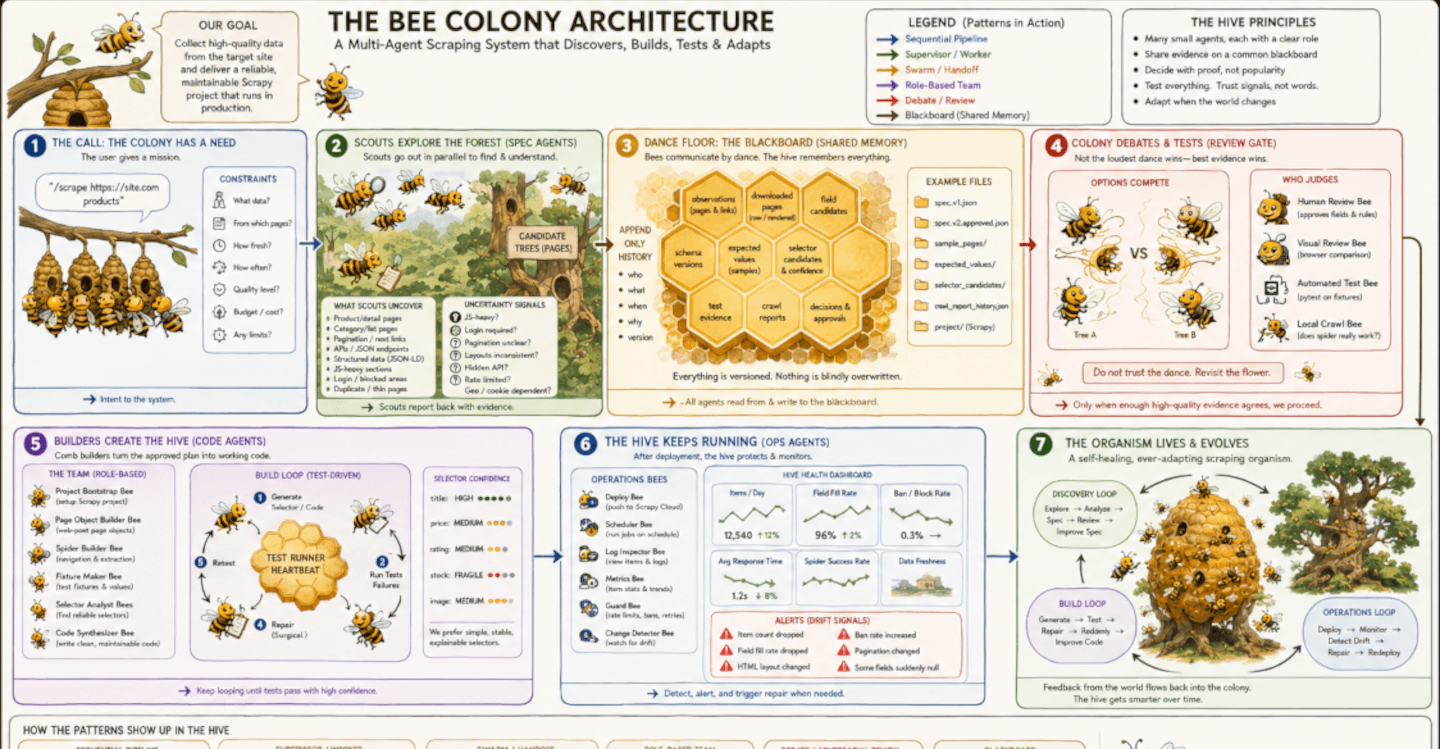
Scraping a single webpage is like plucking one fruit from a tree. Scaling web data collection is more like running an orchard: it requires systems to ensure constant yield, quality, and compliance over time. Beyond writing a scraper, we need to manage massive volumes, recover from failures, and integrate data seamlessly into our workflows—all while staying legally sound.
Scaling a web data collection project involves solving entirely different classes of problems, such as:
Volume: Collecting data from thousands (or more) of websites, handling millions of requests per day.
Reliability: Ensuring scrapers continue functioning despite frequent website changes, anti-scraping measures, and failures.
Infrastructure: Managing proxy rotation, distributed scraping infrastructure, and error recovery at scale.
Compliance: Considering legal and ethical aspects of data collection.
Data Quality: Normalising, deduplicating, and cleaning large, diverse datasets for downstream use.
Integration: Delivering data in real time or in formats compatible with enterprise systems.
Where LLM Scrapers Fall Short
A. Lack of Built-In Scalability:
Let’s say you’ve got an LLM scraper working perfectly for one site. What happens when you need data from hundreds of sites, running thousands of requests at the same time? Most of these tools aren’t built with these needs in mind.
LLM-generated scrapers are great for small jobs but crack under the weight of large-scale demands. Handling millions of requests, rotating proxies, or balancing loads across distributed systems? That’s where these tools hit a wall.
LLM-generated scrapers are typically standalone scripts, not designed for distributed execution across large-scale infrastructure. They often fail to handle high volumes of concurrent requests due to limited support for advanced proxy management or load balancing.
B. No Operational Framework:
Scraping isn’t just about writing scripts—it’s about running an operation. You need scheduling, monitoring, logging, and alerting to ensure things keep moving smoothly. LLM scrapers don’t come with any of that—they leave you to manage all the operational overhead yourself.
Imagine trying to run a factory without an assembly line—you’d spend all your time just keeping the machines running. That’s what these tools feel like when you try to scale them.
Successful web data collection at scale requires an ecosystem: scheduling, orchestration, monitoring, logging, and error tracking. LLM tools rarely offer this operational backbone.
C. Limited Compliance Awareness:
Extracting data isn’t just a technical problem; it’s a legal and ethical one. Most LLM scrapers don’t help you navigate the compliance minefield —you’re left to figure that out yourself.
It’s risky. What seems like a quick win can backfire badly if you end up on the wrong side of a lawsuit or regulatory action.
Extracting data is one thing; doing so ethically and legally is another. LLM scrapers prioritize ease of use but often ignore compliance guardrails. This oversight can turn a quick win into a costly liability.
Many LLM-based tools focus on ease of extraction but do not provide guidance or built-in features for ensuring legal and ethical compliance with data usage. What’s fast and easy today could be risky and expensive tomorrow.
Contrasting with Scalable Solutions
Let’s compare the key features of scalable web data platforms, such as Zyte API on Scrapy Cloud, against the capabilities of LLM-based scrapers:
Dimension
Ease of Use
Volume Handling
Infrastructure
Compliance
LLM-Based Scrapers
High; intuitive interfaces
Low; best for single-site projects
Local execution or basic cloud
Limited or absent
Zyte API on Scrapy Cloud
Requires moderate familiarity with Python to setup and configure
High; handles large-scale, multi-site extraction
Distributed infrastructure with automatic load balancing
Built-in compliance frameworks.
Scaling is the Real Challenge
The true test of a web data collection project is not how easily you can create a scraper, but how well you can scale it into a reliable, efficient, and compliant operation.
The ultimate success of a web data collection project isn’t determined by how quickly you can create a scraper—it’s about whether you can keep it running, growing, and delivering value over time. LLM-driven scrapers may open the door, but scaling requires walking through it with the right tools and strategies.
LLM-driven scrapers are an excellent starting point for small, one-off projects but leave businesses stranded when they attempt to scale.
The missing pieces are the operational infrastructure, resilience, and enterprise-grade capabilities required for large-scale data collection.
LLM scraping solutions will only achieve their full potential when they evolve beyond easy scraper creation to address the scaling challenges that define successful web data collection.