Ecommerce Web Scraping Services
Collect quality, accurate product data from the biggest e-commerce websites and product marketplaces in the world.
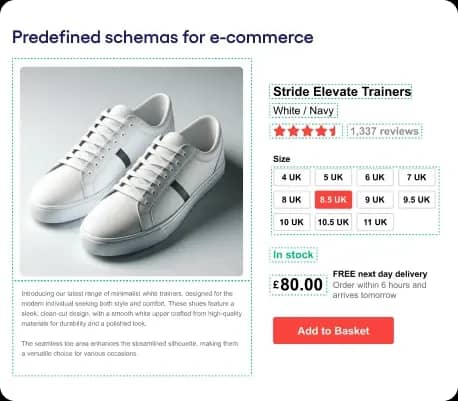
Wide data coverage for product details, prices, reviews, ratings, availability, and more
No setup costs for common data types supported by AI
In-house legal experts ensure full GDPR and global compliance
What data categories are typically extracted when scraping products?
Standardized and pre-defined product data feed to reduce the price and setup time, and provide additional Quality Assurance out of the box.
Product name
Price / Currency
Availability
Description
MPN/GTIN/SKU
Brand
Breadcrumbs
Image URL
Rating
URL
Pagination
Reviews
-(1).png&w=3840&q=70)
Product data comes in all shapes and sizes. We get it all.
E-commerce stores
Websites that sell products directly to consumers, such as supermarkets, grocers, factory outlets, and specialist stores.
E-commerce marketplaces
Highly dynamic and valuable data scraping sources.
These marketplace websites generally cover an extremely broad and deep range of products often supplied by 3rd parties.Industrial and machine parts catalog
Websites that provide information about industrial and mechanical parts.
Food and restaurant directories
Data collection from websites that provide information about restaurants, menus, and food delivery services.
Real estate and property
Websites that provide information about properties for sale or rent past and present.
E-tailers
Extract information from B2C online retailers that operate exclusively through their websites, without physical stores.
Pay-per-view and streaming websites
Get pricing and other related data from websites offering digital entertainment products such as music and video streams/downloads.
Manufacturer's product information portals
Manufacturer’s product catalogs and product information websites with specs and supporting information.
Product review websites
Data collection from websites that contain reviews which can be useful for product and feature analysis.
Event websites
Data extraction from multiple pages provides information about upcoming events, conferences, and trade shows in a particular industry or location.
Web 3 and digital asset marketplaces
Scrape data from platforms that allow users to buy, sell and trade various digital assets such as cryptocurrencies, non-fungible tokens (NFTs), and other digital tokens.
Social media and user-generated content websites
Social media Forums and discussion boards are popular sources of data extraction for content and product reviews.
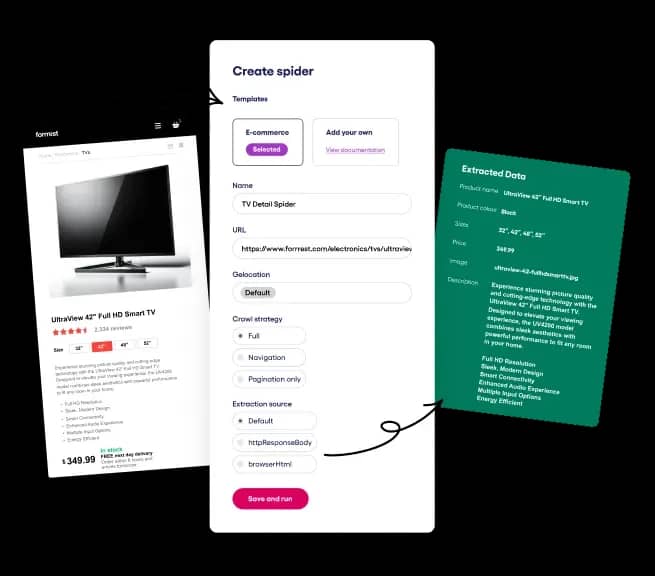
Our tech stack is your tech stack.
Battle-tested AI
We've spent years building the most innovative AI technology for web scraping — technology that thousands of dev teams use globally. The resulting efficiency has driven down setup and maintenance costs for our customers.
Solving website bans
We manage and solve bans at scale! Delegate the headache of bypassing bans to Zyte, and never touch another proxy. No one does it faster and more affordably. In fact, we were named the best option for unblocking APIs for success rate, speed and cost.
Spider hosting at scale
We manage every aspect of your web scraping infrastructure, including hosting and managing spiders. This is a huge infrastructure undertaking for in-house web scraping teams, and we use our own Scrapy Cloud technology to make sure it gets done right.
LLM integrations
Our own, supervised AI is the foundation of our tech stack, but at times, large language models can supercharge a web scraping project. We know exactly when to use LLMs in web scraping, and we're the best at it.
Get started quickly
Our AI-powered tech stack allows us to onboard and start collecting data quickly after you decide to work with us. Ready? Let's go!
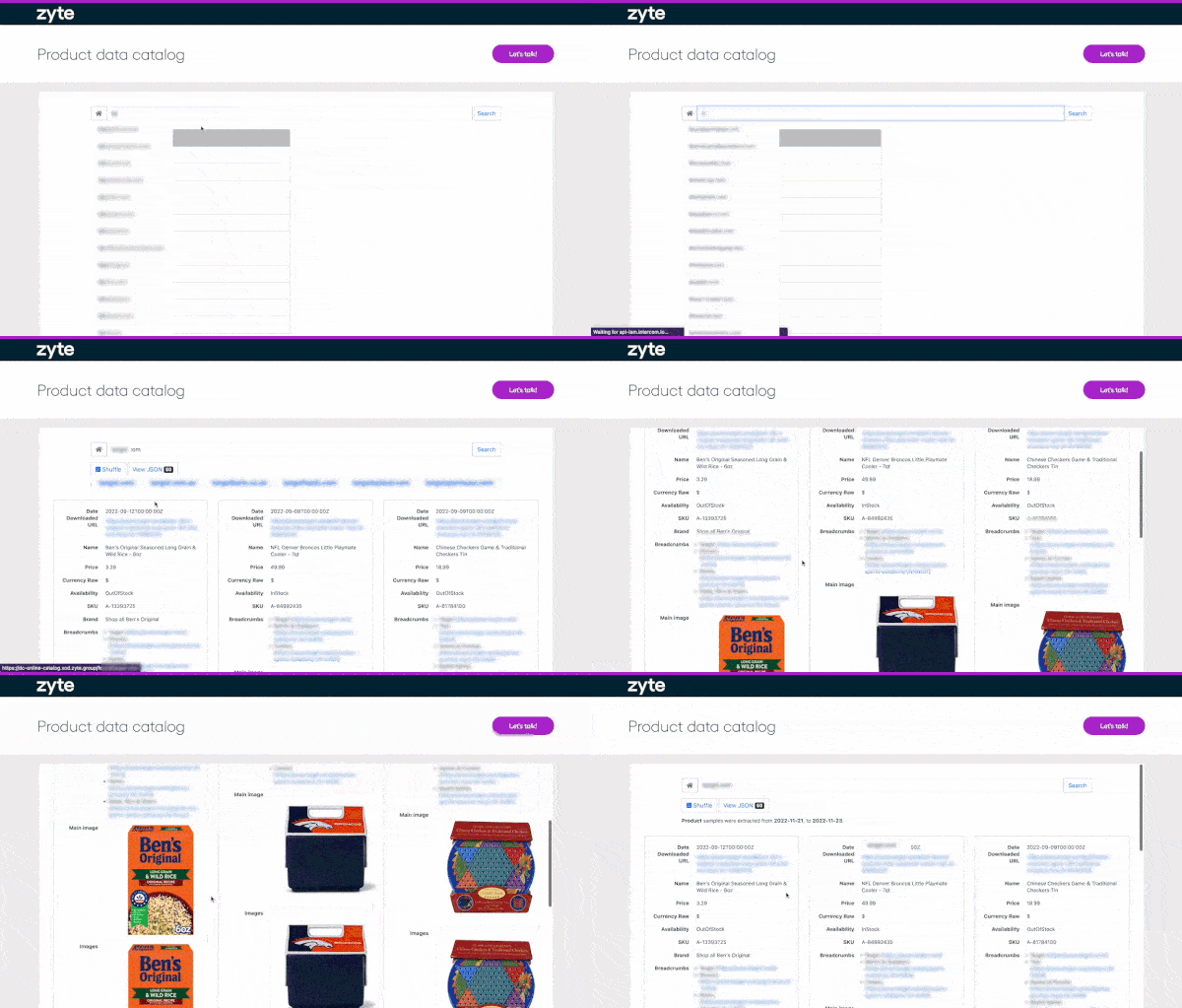
Get inspired: See sample product data
Explore sample product data and examples of websites regularly scraped for our Zyte Data customers.
How will you use product data from e-commerce websites?
Price comparison, enforcement, and monitoring
Use e-commerce product scraper to aggregate and compare prices of products across different retailers and marketplaces to help inform your pricing strategy and manage resellers.
Market research
Product scrapers are great to analyze trends and monitoring competition, for data-driven business decision-making.
E-commerce optimization
Optimize product pages for search engines, by using web scrapers to identify the most commonly used keywords and incorporating them into the content.
Product development
Product reviews and comments data extraction using web scraping tools and services can give insights into customer preferences to help improve products or identify gaps in the market for products that better meet consumer needs.
Building models with AI
As AI and machine learning become more prevalent, scraped product data is being used to train algorithms to recognize patterns and make predictions about consumer behavior and market trends.
Reputation management
Scrape data for monitoring news and reviews can help identify areas of improvement and allow businesses to respond to market feedback in a timely manner.
Classifieds monitoring
Monitor classifieds ads and scraped data from used product marketplaces to better understand descriptions, photography, and resale value.
Price optimization
Use web scrapers to optimize pricing strategy by analyzing competitors' prices and adjusting accordingly to maximize profits.
More ways to use product data:
Distribution tracking
Trend/category analysis
Inventory intelligence
Enrich product catalogs
Content creation
Fraud detection
Supply chain optimization
Ticket price monitoring
Your fastest route to accurate product data
Our Data Extraction Team is ready to get started on your project. Schedule your quick, no-pressure consultation.
Standard Data Schema
No set up costs
Per website from
$
450
/month 1M Records
Don’t waste time scraping the same product and e-commerce websites we already do regularly. Choose from a whole website, product categories or specific URLs/products.
Custom Data Schema
Set up $100- $600
Per website from
$
450
/month 1M Records
Use our team, our technology and our expertise to get the data you need. Data quality assurance. Flexibility to extend the standard schema and add a custom selection of records.
Product data feeds for your business
For businesses that don’t have in-house web data developers but need accurate product data at scale.
Average of 99.99% data accuracy
Built-in compliance
Data when you need it
Complete product data web scraping service for any business
Standard and bespoke web data extraction projects
Frequently asked questions
Is Zyte the same as Scrapinghub?
Different name. Same company. And with the same passion to deliver the world’s best data extraction service to our customers. We’ve changed our name to show that we’re about more than just web scraping tool. In a changing world Zyte is right at the cutting edge of delivering powerful, easy to use solutions that help our customers stay ahead in today’s fast-moving, data-driven world.
What support do you offer?
We offer all our customers no-cost support on coverage issues, missed deliveries and minor site changes. If there’s a larger website data extraction change that requires a complete spider overhaul this may incur an additional cost.
Can I try Zyte before buying?
Yes, if we have sample data available for the source you want to be scraped. If it’s a new source we haven’t crawled before we will share sample data with you following development kick-off. This occurs post purchasing. For product or news & article data, you can free trial our Automatic Extraction product via an easy-to-use user interface.
Talk to us about your requirements
How can Zyte help me extract website content?
Zyte Data extraction services is an end-to-end solution that can help you with web content extraction. It’s the most hassle-free way to get clean structured data; quickly and accurately. But if you’re looking for a DIY option, Zyte offers web data extraction tools to make your job easier.
What is meant by data extraction?
Data extraction is described as the automated process of obtaining information from a source like a web page, document, file or image. This extracted information is typically stored and structured to allow further processing and analysis.
Extracting data from Internet websites - or a single web page - is often referred to as web scraping. This can be performed manually by a person cutting and pasting content from individual web pages. This is likely to be time-consuming and error-prone for all but the smallest projects.
Hence, data extracting is typically performed by some kind of data extractor - a software application that automatically fetches and extracts data from a web page (or a set of pages) and delivers this information in a neatly formatted structure.
This is most likely a spreadsheet or some kind of machine-readable data exchange format such as JSON or XML. This extracted data can then be used for other purposes, either displayed to humans via some kind of user interface or processed by another program.
Why is data extraction important?
There’s a vast amount of information out there on the Internet. Extracting and aggregating data from public-domain websites and other digital sources - also known as web data scraping - can give you a significant business edge over your competitors.
Data extracting generates insights that can help companies analyze the performance of a particular product in the marketplace, track customer sentiments expressed in online reviews, monitor the health of your brand, generate leads, or compare price information across different marketplaces.
It also gives researchers a powerful tool to study the performance of financial markets and individual companies, guide investment decisions and shape new products.
There are many non-financial uses for data extraction, such as scraping news websites to monitor the quality and accuracy of stories or to monitor trends in reporting. It’s also used to obtain information from public institutions, for example, to track contract awards and hence investigate possible corruption.
Data extraction can significantly streamline the process of getting accurate information from other websites that your own organization needs to survive and thrive.
What is a data extraction example?
There’s a vast range of applications and use cases for website data scraping. One popular example where data extraction is widely used comes from the world of retail and e-commerce. It’s an invaluable tool for competitor price monitoring, allowing companies – and market researchers – to monitor the pricing of rivals’ products and services. Manually tracking competitors’ prices that may change on a daily basis isn’t practical - especially if you’re monitoring the pricing of hundreds or thousands of different products. A data scraping tool automates this process, scraping pricing data from e-marketplaces and competitors’ websites quickly and reliably.