Solving one of the most complicated challenges for Project Managers running web data extraction projects
Every web extraction project manager eventually faces a common dilemma: Should I assemble a web scraping team to build spiders or buy web data from a provider?
Given the high complexity of web data extraction, this seemingly simple challenge has many nuances. It involves building a solid business case, addressing bans regularly, and post-processing data to ensure quality standards.
Pair these challenges with a typically large group of stakeholders—both technical and non-technical, in-house and external—and the legal risks of handling personal data or agreeing to binding website terms, and the complexity multiplies.
Zyte has been sourcing data for some of the world’s biggest companies for over 14 years. Our refined processes and proprietary technology have been optimized for efficiency and cost-effectiveness, culminating in a simple three-step decision-making framework for accessing web data:
Define priorities for cost, time, and quality.
Build a scope for a POC or MVP, regardless of project size.
Decide between build, buy, or hybrid web extraction methods.
Let’s break down each step.
Defining your business priorities
The Golden Triangle of Project Management illustrates the restrictive interplay of three key factors: cost, time, and quality. Achieving a simultaneously cheap, fast, and high-quality project is conceptually impossible because each dimension competes for limited resources.
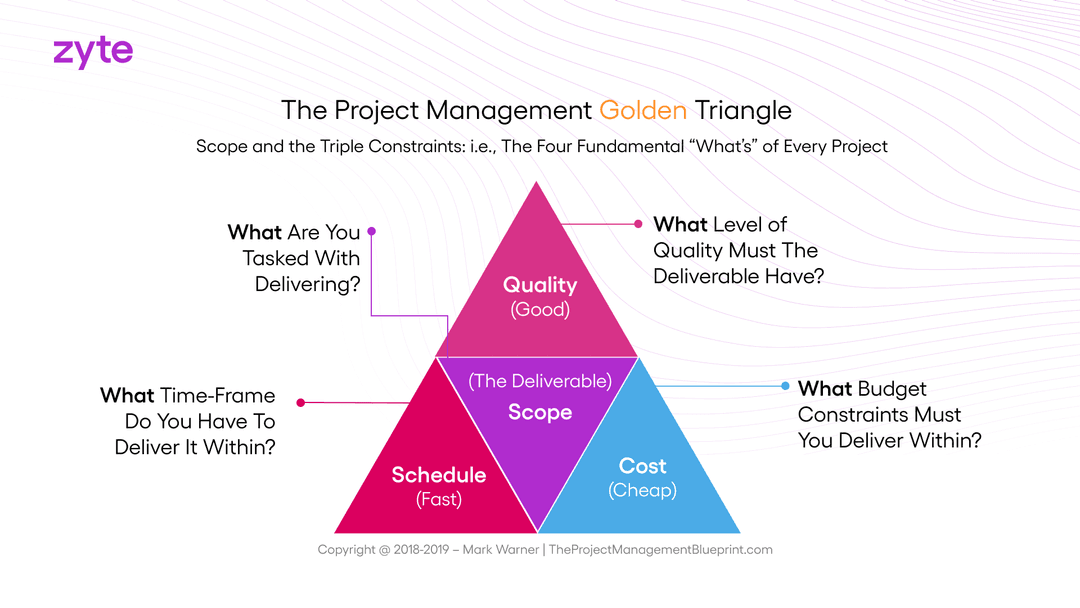
This framework underscores the importance of scoping.
Scoping involves choosing priorities and limitations from a business or project management perspective, making subsequent decisions significantly easier.
For web extraction, each dimension entails specific considerations:
Time: Factors like website complexity, data volume, and resource availability influence the timeline. Planning, stakeholder interactions, maintenance, and quality assurance also demand time.
Cost: Costs include tools, hiring, and overhead expenses like hosting and storage.
Quality: Quality reflects the accuracy and completeness of data. Scraping tools, developer skills, and data processing levels all affect it.
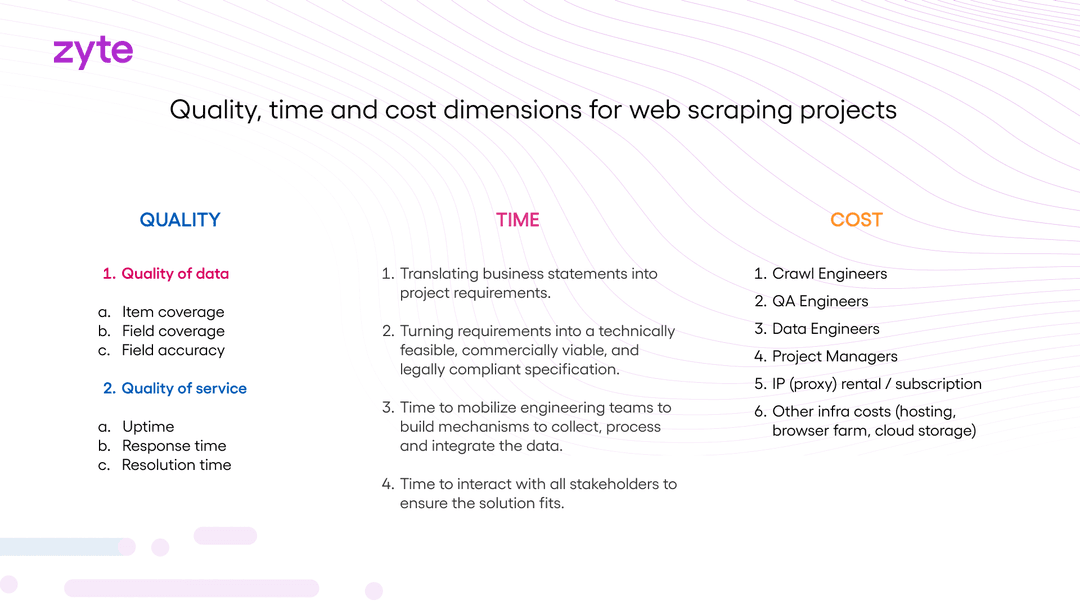
A well-defined scope in your business case should detail how fast, accurate, and cost-effective data will be obtained and highlight the necessary investments. Prioritizing these dimensions guides the evaluation of extraction methods. To better understand your project’s limitations, consider questions like:
Technical Expertise: Does your team have the skills to build and maintain a web scraping tool?
Time: Do you need data immediately, or do you have time to develop a solution?
Resources: Can your business afford the required resources for an in-house tool?
Data Needs: How complex are your data needs? Would a third-party tool suffice?
Maintenance: Are you equipped to manage ongoing maintenance and updates?
Building a Web Scraping Solution
Building an in-house solution offers a high degree of customization, allowing businesses to tailor tools for specific needs. However, this approach can be resource-intensive, requiring skilled developers, ongoing maintenance, and significant time investment.
For example, an e-commerce company built a custom tool to track competitor pricing. Initially, the tool provided accurate and timely data, but it failed as websites updated their structures. This led to inaccurate data and missed deadlines, exposing the hidden costs of building and maintaining in-house solutions.
Buying a Web Scraping Solution
Purchasing data from a provider offers several benefits, including time and resource savings.
Ready-to-use solutions often include dedicated support, sparing your team from technical complexities. However, these tools may need more customization of an in-house solution and come with ongoing delivery costs.
A financial services firm seeking stock market trends chose to buy a scraping solution. Building an in-house tool was not feasible due to time and expertise constraints. The ready-to-use data proved invaluable for their operations, justifying the costs.
The Hybrid Approach
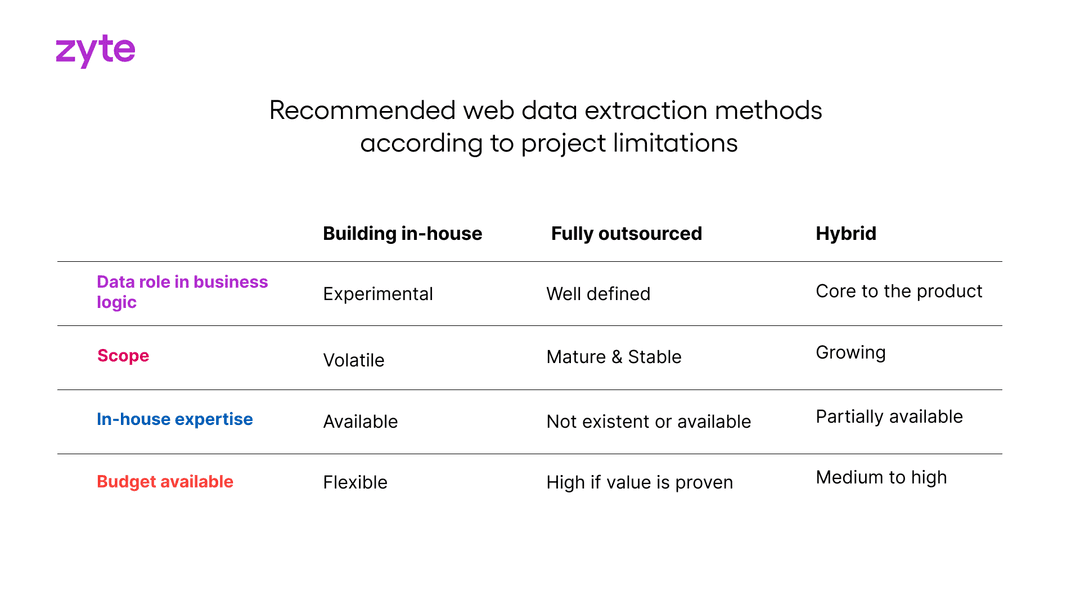
Many businesses find a hybrid approach most effective. They use third-party solutions for general data needs while developing in-house tools for more specialized tasks.
For instance, a market research firm might purchase data for broad market trends but build in-house tools for nuanced research data. This approach balances cost, customization, and maintenance.
Whether you build, buy, or choose a hybrid model, aligning your web data strategy with business goals ensures that your project delivers value.
Effectively leveraging data can transform your products and drive business success.