PINGDOM_CHECK

#ExtractSummit2026 The world's largest web scraping conference returns. Austin Oct 7–8 · Dublin Nov 10–11.

Register now
Data Services
Pricing
Login
Try Zyte APIContact Sales
  • Unblocking and Extraction

    Zyte API

    The ultimate API for web scraping. Avoid website bans and access a headless browser or AI Parsing

    Ban Handling

    Headless Browser

    AI Extraction

    SERP

    Enterprise

    DocumentationSupport

    Hosting and Deployment

    Scrapy Cloud

    Run, monitor, and control your Scrapy spiders however you want to.

    Coding Agent Add-Ons

    Agentic Web Data

    Plugins that give coding agents the context to build production Scrapy projects. Starts with Claude Code.

  • Data Services
  • Pricing
  • Browse

    • BlogArticles, podcasts, videos
    • Case studiesCustomer outcomes
    • White papersIn-depth reports
    • EventsConferences, webinars, recordings

    Subscribe

    • NewsletterSwiftly delivered
    • Discord communityExtract Data community
  • Product and E-commerce

    From e-commerce and online marketplaces

    Data for AI

    Collect and structure web data to feed AI

    Job Posting

    From job boards and recruitment websites

    Real Estate

    From Listings portals and specialist websites

    News and Article

    From online publishers and news websites

    Search

    Search engine results page data (SERP)

    Social Media

    From social media platforms online

  • Meet Zyte

    Our story, people and values

    Contact us

    Get in touch

    Support

    Knowledge base and raise support tickets

    Terms and Policies

    Accept our terms and policies

    Open Source

    Our open source projects and contributions

    Web Data Compliance

    Guidelines and resources for compliant web data collection

    Join the team building the future of web data
    We're Hiring
    Trust Center
    Security, compliance & certifications
Login
Try Zyte APIContact Sales

Zyte Developers

Coding tools & hacks straight to your inbox

Become part of the community and receive a bi-weekly dosage of all things code.

Join us
    • Zyte Data
    • News & Articles
    • Search
    • Social Media
    • Product
    • Data for AI
    • Job Posting
    • Real Estate
    • Zyte API - Ban Handling
    • Zyte API - Headless Browser
    • Zyte API - AI Extraction
    • Web Scraping Copilot
    • Zyte API Enterprise
    • Scrapy Cloud
    • Solution Overview
    • Blog
    • Webinars
    • Case Studies
    • White Papers
    • Documentation
    • Web Scraping Maturity Self-Assesment
    • Web Data compliance
    • Meet Zyte
    • Jobs
    • Terms and Policies
    • Trust Center
    • Support
    • Contact us
    • Pricing
    • Do not sell
    • Cookie settings
    • Sign up
    • Talk to us
    • Cost estimator
All articles
AI60, 60 articles
Data quality13, 13 articles
Developer interest57, 57 articles
Integration2, 2 articles
Open-source40, 40 articles
Proxies29, 29 articles
Scraping practice17, 17 articles
Scraping strategy26, 26 articles
Web data60, 60 articles
Web scraping APIs33, 33 articles
Zyte API59, 59 articles
Scrapy48, 48 articles
Scrapy Cloud10, 10 articles
Web Scraping Copilot12, 12 articles
AI & Machine Learning1, 1 articles
Automotive2, 2 articles
E-commerce & retail26, 26 articles
Entertainment & Streaming2, 2 articles
Financial Services8, 8 articles
Government2, 2 articles
Market Research & Intelligence3, 3 articles
Media & publishing8, 8 articles
Real Estate2, 2 articles
Recruitment & HR3, 3 articles
Transportation & Logistics2, 2 articles
Travel & hospitality2, 2 articles
Extract Summit25, 25 articles
PyCon1, 1 articles

Appearance

Discord Community
BlogOpen-sourceImproving Access to Peruvian Congress Bills with Scrapy
ArticleOpen-source

Improving Access to Peruvian Congress Bills with Scrapy

Improving Access to Peruvian Congress Bills with Scrapy - Learn how Scrapy is improving access to Peruvian Congress bills for greater transparency.

P

Pablo Hoffman

4 min read · July 13, 2016

Improving Access to Peruvian Congress Bills with Scrapy

Improving access to Peruvian Congress bills with Scrapy

Many governments worldwide have laws enforcing them to publish their expenses, contracts, decisions, and so forth, on the web. This is so the general public can monitor what their representatives are doing on their behalf.

However, government data is usually only available in a hard-to-digest format. In this post, we'll show how you can use web scraping to overcome this and make government data more actionable.

Congress Bills in Peru

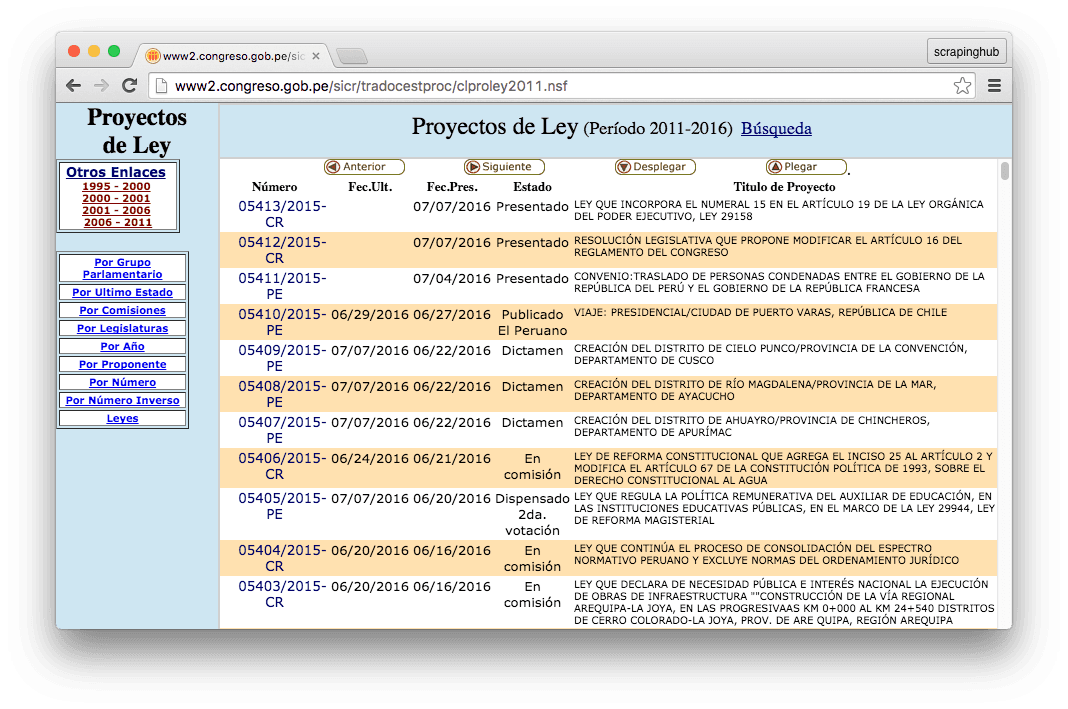
For the sake of transparency, Peruvian Congress provides a website where people can check the list of bills that are being processed, voted and eventually become law. For each bill, there’s a page with its authorship, title, submission date and a brief summary. These pages are frequently updated when bills are moved between commissions, approved and then published as laws.

By having all of this information online, lawyers and the general public can potentially inspect bills that could be the result of lobbying. In Peruvian history, there have been many laws passed that were to benefit only one specific company or individual.
Screen Shot 2016-07-13 at 9.52.11 AM

However, having transparency doesn’t mean it’s accessible. This site is very clunky, and the information for each bill is spread across several pages. It displays the bills in a very long list with far too many pages, and until very recently there has been no way to search for specific bills.

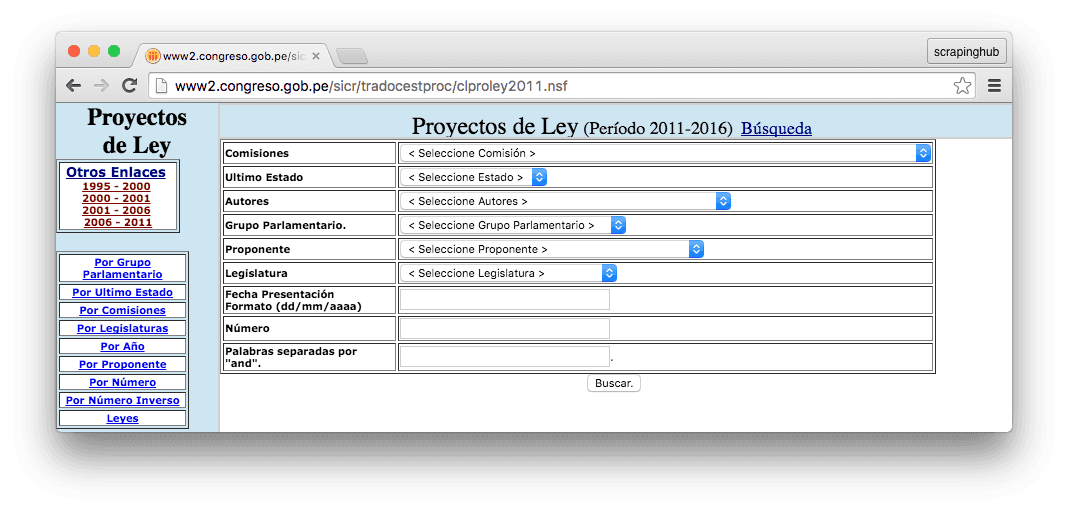
In the past, if you wanted to find a bill, you would need to look through several pages manually. This is very time consuming as there are around one thousand bills proposed every year. Not long ago, the site added a search tool, but it’s not user-friendly at all:
Screen Shot 2016-07-13 at 9.53.53 AM

The Solution

My lawyer friends from the Peruvian NGOs Hiperderecho.org and Respeto.pe asked me about the possibilities to build a web application. Their goal was to organize all the data from the Congress bills, allowing people to easily search and discover bills by keywords, authors and categories.

The first step in building this was to grab all bill data and metadata from the Congress website. Since they don’t provide an API, we had to use web scraping. For that, Scrapy is a champ.

I wrote several Scrapy spiders to crawl the Congress site and download as much data as possible. The spiders wake up every 8 hours and crawl the Congress pages looking for new bills. They parse the data they scrape and save it into a local PostgreSQL database.

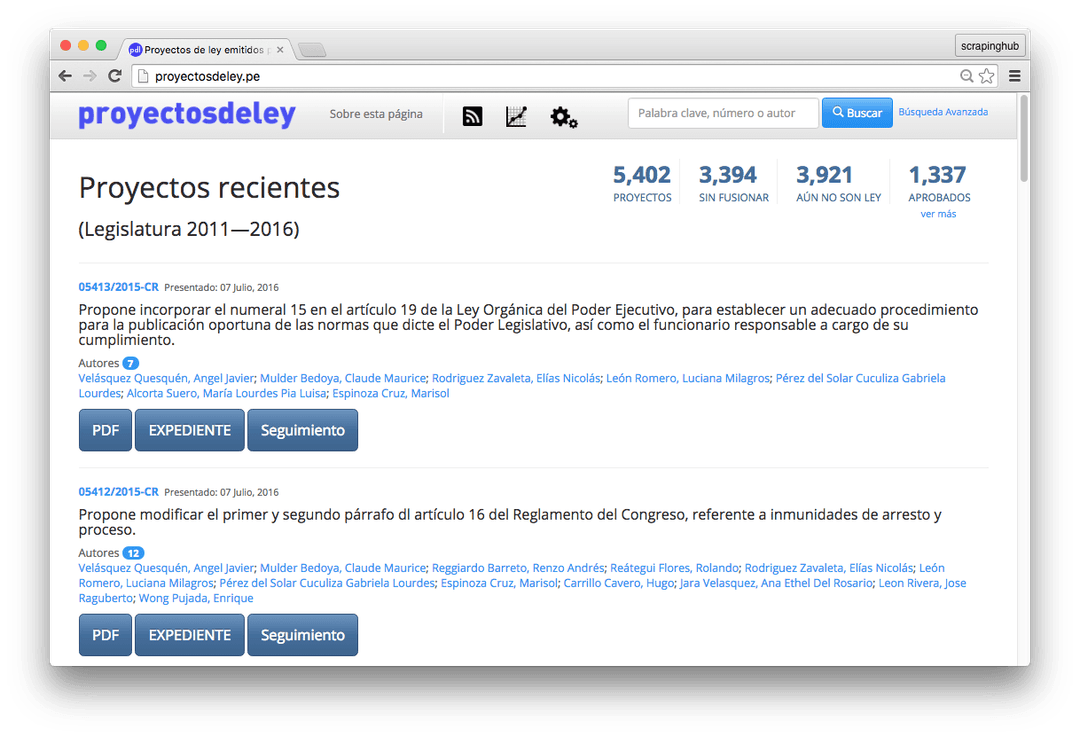
Once we had achieved the critical step of getting all the data, it was relatively easy to build a search tool to navigate the 5400+ bills and counting. I used Django to create a simple interface for users, and so ProyectosDeLey.pe was born.
Screen Shot 2016-07-13 at 10.09.55 AM

The Findings

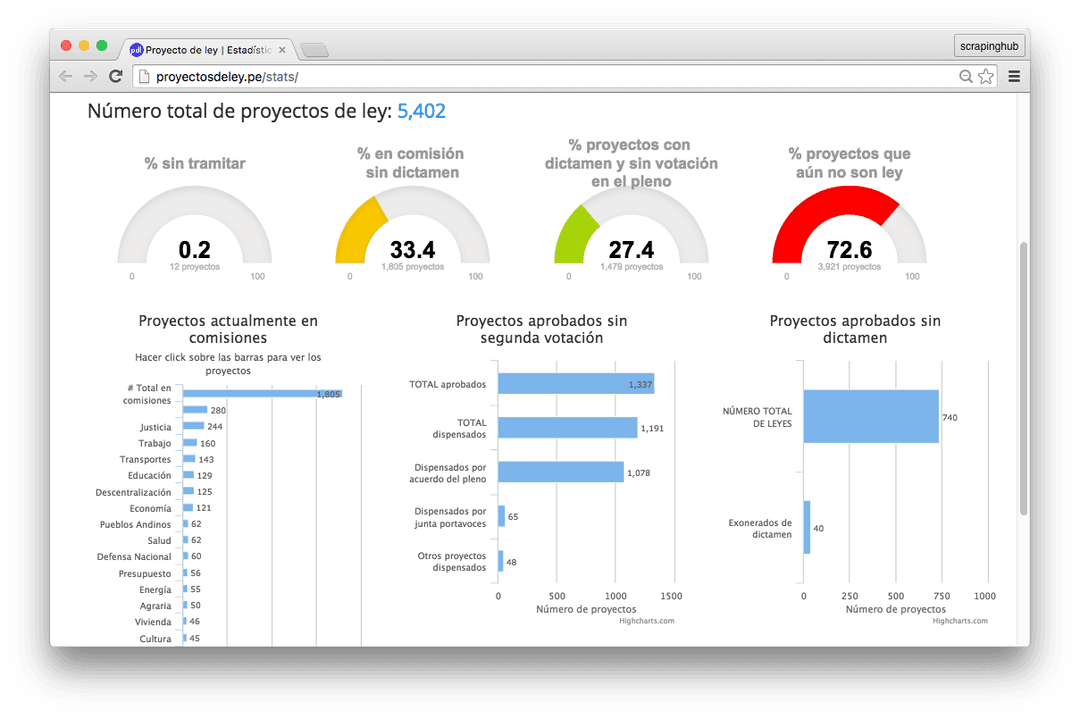
All kinds of possibilities are open once we have the data. For example, we could now generate statistics on the status of the bills. We found that of the 5402 proposed bills, only 740 became laws, meaning most of the bills were rejected or forgotten on the pile and never processed.
Screen Shot 2016-07-13 at 10.15.01 AM

Quick searches also revealed that many bills are not that useful. A bunch of them are only proposals to turn some specific days into "national days".

There are proposals for national day of peace, "peace consolidation", "peace and reconciliation", Peruvian Coffee, Peruvian Cuisine, and also national days for several Peruvian produce.

There were even more than one bill proposing the celebration of the same thing, on the very same day. Organizing the bills into a database and building our search tool allowed people to discover these redundant and unnecessary bills.

Call In the Lawyers

After we aggregated the data into statistics, my lawyer friends found that the majority of bills are approved after only one round of voting. In the Peruvian legislation, dismissal of the second round of voting for any bill should be carried out only under exceptional circumstances.

However, the numbers show that the use of one round of voting has become the norm, as 88% of the bills approved were only done so in one round. The second round of voting has been created to compensate for the fact that the Peruvian Congress has only one chamber were all the decisions are made. It’s also expected that members of Congress should use the time between first and second voting for further debate and consultation with advisers and outside experts.

Bonus

The nice thing about having such information in a well-structured machine-readable format, is that we can create cool data visualizations, such as this interactive timeline that shows all the events that happened for a given bill:
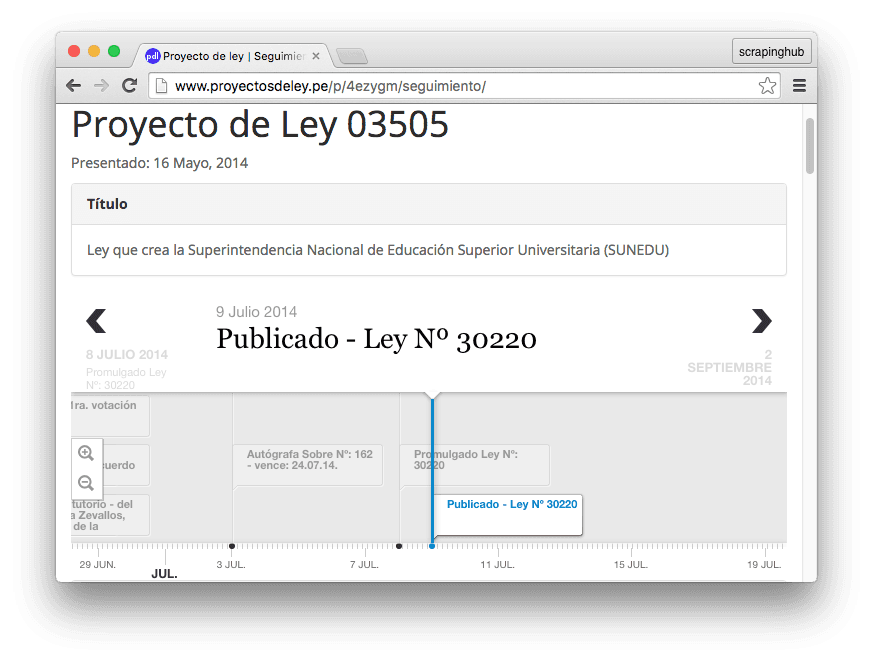
Screen Shot 2016-07-13 at 10.27.19 AM

Another cool thing is that this data allows us to monitor Congress’ activities. Our web app allows users to subscribe to a RSS feed in order to get the latest bills, hot off the Congress press. My lawyer friends use it to issue "Legal Alerts" in the social media when some of the bills intend to do more wrong than good.

Wrap Up

People can build very useful tools with data available on the web. Unfortunately, government data often has poor accessibility and usability, making the transparency laws less useful than they should be. The work of volunteers is key in order to build tools that turn the otherwise clunky content into useful data for journalists, lawyers and regular citizens as well. Thanks to open source software such as Scrapy and Django, we can quickly grab the data and create useful tools like this.

See? You can help a lot of people by doing what you love! 🙂
Try Zyte API

Build your first scraper in minutes

Free trial, no credit card. From a single request to production in an afternoon.

Get started
Open-source
P

Pablo Hoffman

More from this author

In this article

  • Congress Bills in Peru
  • The Solution
  • The Findings
  • Call In the Lawyers
  • Bonus
  • Wrap Up

Follow

Get the latest

Zyte and the data web in your inbox — or wherever you already are.

Subscribe

Or follow elsewhere

Continue reading

Scrapy in 2026: New release brings modern async crawling standards
Open Source

Scrapy in 2026: New release brings modern async crawling standards

Scrapy 2.14.0 is released with a major under-the-hood modernization. Say goodbye to Twisted Deferreds.

Robert Andrews·6 min·January 12, 2026
The new economics of web data: Smaller scraping just got cheaper
Open Source

The new economics of web data: Smaller scraping just got cheaper

Smarter tools and AI-driven automation are rewriting the rules of web scraping. As costs fall and setup barriers vanish, smaller teams can now compete at scale, reshaping how the web’s data economy works.

Theresia Tanzil·2 mins·October 6, 2025
A Deep Dive into Zyte's Open-Source Libraries
Open Source

A Deep Dive into Zyte's Open-Source Libraries

Discover how Zyte’s open-source libraries like ClearHTML, Extruct, Chomp.js, and more simplify web data extraction and processing.

Neha Setia Nagpal·1 mins·December 19, 2024

The Community · Newsletter

The best of Zyte and the data web, in your inbox.

One curated edition — new articles, product updates, and the stories shaping the data web. No noise.

G2.com

Capterra.com

Proxyway.com

EWDCI logoMost loved workplace certificateZyte rewardISO 27001 iconG2 rewardG2 rewardG2 reward

© Zyte Group Limited 2026