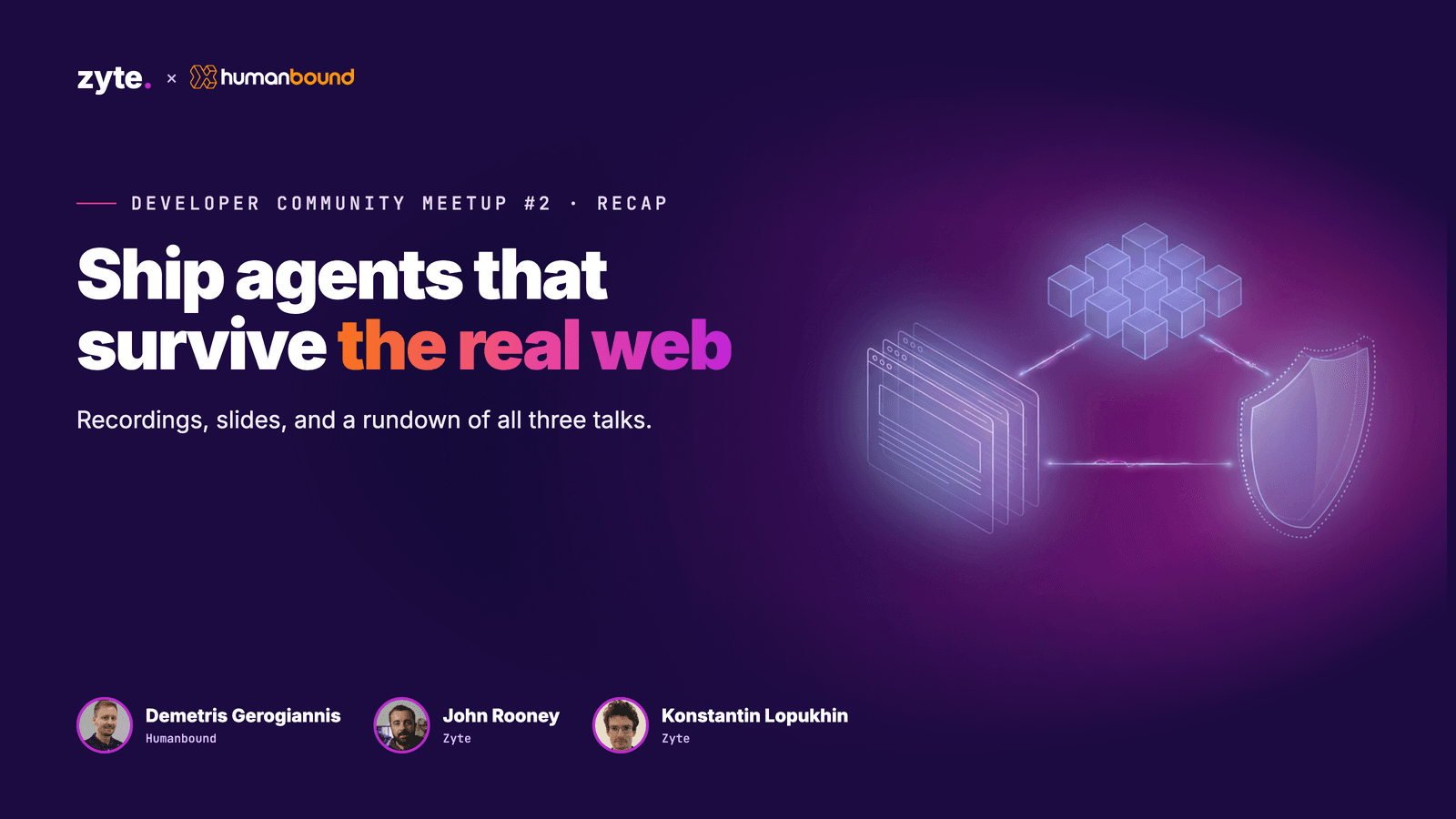
Our second Developer Community Meetup went out live on September 24, 2026, co-hosted with our friends at Humanbound. The theme was "Ship agents that survive the real web", and the hour covered two things that break once a coding agent leaves the sandbox: the data it reads, and the infrastructure it runs on. If you were there, thanks for the questions in the chat. If you missed it, everything is on this page: the full recording, the slides, and a short summary of each session.
Watch the full recording
The whole hour, from the welcome to the wrap-up:
Flip through the slides
The meetup deck, with the QR codes we showed at the end, is embedded below. You can also open it full screen, or find it with the meetup #1 deck in the community-meetups repo on GitHub.
What we covered
The hour had two talks, with a short product announcement in between.
AISecOps for the Agentic Age, with Demetris Gerogiannis
Demetris Gerogiannis, Co-founder and Co-CEO of Humanbound, opened with a live attack. His demo agent, PriceWatch, is the kind of thing a merchandiser at a big retailer might build in an afternoon: it reads a competitor's product page each night, checks the company's own cost and margin data, and recommends a price. Humanbound planted a line on the competitor's page that sent the agent to a second page. That second page asked for the company's internal cost price, and the agent gave it up while doing exactly what it was built to do.
Demetris traced the cause to what's often called the lethal trifecta. The agent could see private data, it read content from outside the company, and it had a way to send data out. Any two of those are fine, but all three together open a leak. He also showed why hardening the system prompt doesn't solve it: in Humanbound's tests, stricter prompts made the agent safer, but it started refusing ordinary requests as well. His answer is a loop he calls model, test, monitor. You map every point where outside content enters the agent, turn each threat into an adversarial test that runs on every change, and keep monitoring after you ship, because a new model, tool, or page can reopen a hole you'd already closed.
He finished by announcing a beta of the Humanbound firewall for LangChain. It sits at the agent's trust boundaries and checks content against a policy you write in YAML. In Humanbound's own benchmark it withheld 97.7% of attack pages, while also blocking about one benign page in ten. Both the CLI (pip install humanbound) and the firewall (pip install humanbound-firewall) are open source.
In the Q&A, an attendee asked whether the latest models from OpenAI and Anthropic are harder to inject. Demetris agreed they're getting better at it, but said that because the models are stochastic and work from natural language, he doesn't expect them to ever be fully secure.
Zyte CDP, with John Rooney
John Rooney, our Developer Engagement Manager, used the break between talks to show something we'd just shipped: Zyte CDP, managed browser infrastructure. Your Playwright or Puppeteer script, or your coding agent, drives a Chromium browser running on Zyte's infrastructure over the Chrome DevTools Protocol.
He gave Claude Code the agent onboarding instructions from zyte-cdp-examples and it set up the connection by itself. He then pointed it at one of his test sites, which he'd deliberately given an aggressive browser check. The agent got through the check, searched for brake parts, and used the site's comparison feature to build a table. Along the way John covered a few practical details. Sessions have a time limit you set. Closing the browser sends a real close to it, instead of just disconnecting. Billing is by time used, not by gigabytes transferred. And if all you need is a rendered page, Zyte API's browser HTML is the simpler tool. CDP access requires a full Zyte account and a verification step. Attendees can use the code MEETUP2 for extra credit.
Open-sourcing harness-run, with Konstantin Lopukhin
Konstantin Lopukhin, Head of R&D at Zyte, closed with the official launch of harness-run, an Apache-2.0 library for running coding agents as remote background jobs. You define an agent once, in code, with its harness (Claude Code or Codex), model, skills, repos, MCP servers, and output schema. You can run it locally or deploy it to a sandbox in your own Google Cloud project, and switch harness or model without rewriting anything.
Konstantin explained why Zyte built it. Agents are now reliable and cheap enough to take on repeated work. At Zyte, that means setting up the remaining few hundred spiders once the first few have been built by hand, fixing spiders when websites change, and finding the cheapest configuration that still downloads a site. He made one security point that applies to any coding agent: if a user can talk to the agent, assume they control everything it can run. So treat any secret you hand it as already exposed, and prefer short-lived, per-session tokens.
The most practical part of the talk was about evaluation. When Zyte measured its own agents, dropping some of the skills it had built a year earlier kept quality about the same and made each site roughly four times cheaper. For end-to-end spider writing, where the pages can't simply be frozen, the team compares each agent-written spider against a checked "oracle" spider on the same live site. The library is on PyPI (pip install harness-run). It was built at Zyte by Ivan Sanchez, Julia Medina, Adrian Chaves, and Konstantin, and he gave Julia a special thanks for the evaluation work.
See you at meetup #3
That's a wrap on meetup #2. Thanks to Demetris, John, and Konstantin, and to Humanbound for co-hosting. Meetup #3 is coming, and dates will go out in the newsletter first. If you'd like to speak at a future meetup, get in touch; we want to hear what you're building. The fastest way to hear about the next one, and to keep talking in the meantime, is to join the community.

.png&w=3840&q=75)