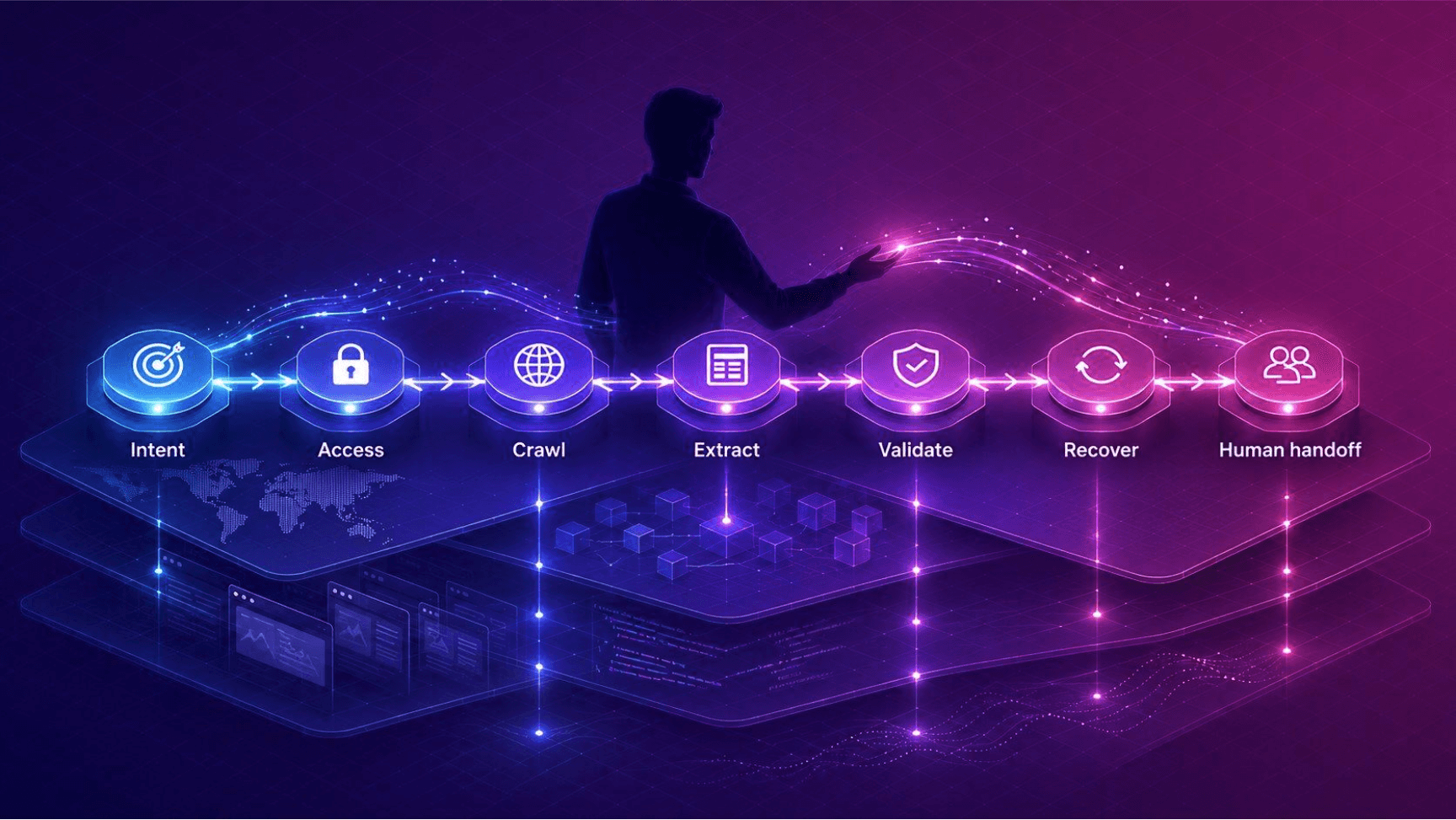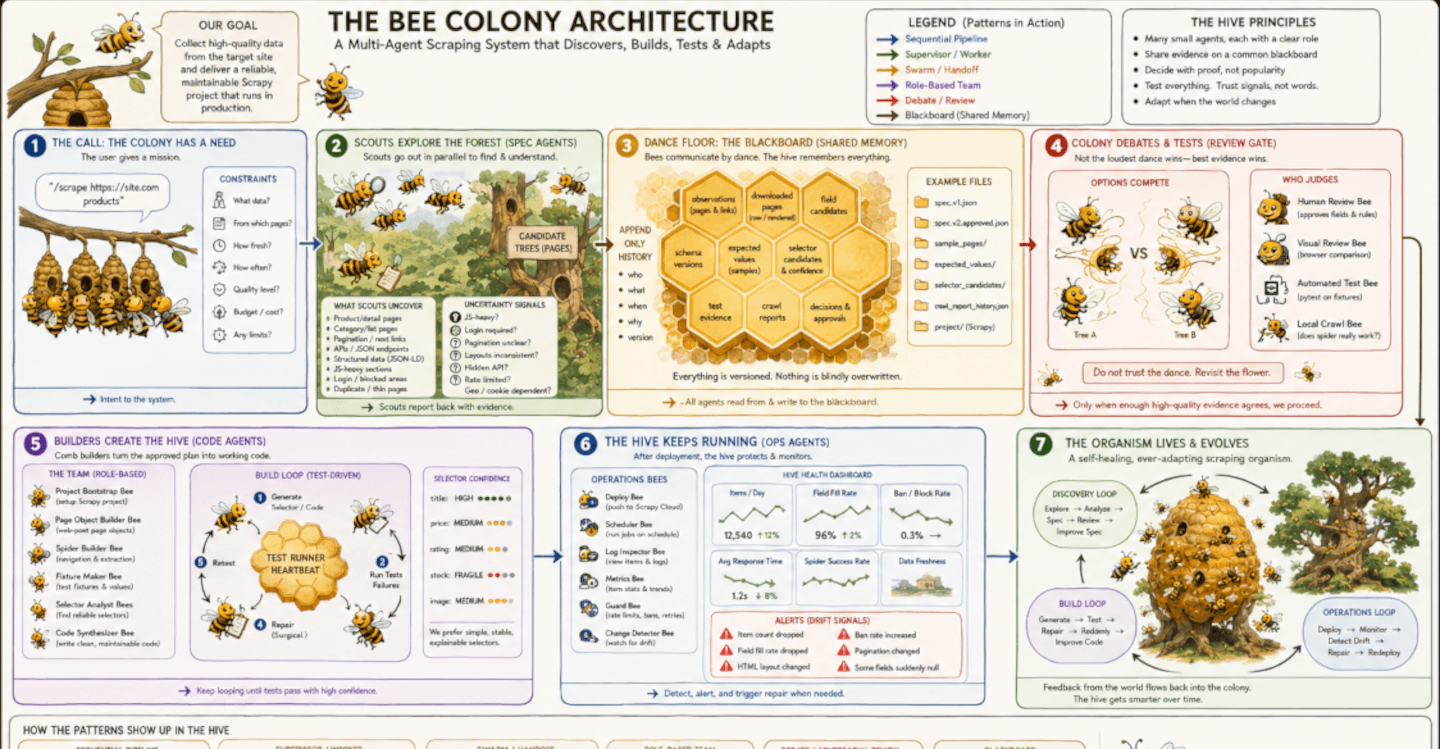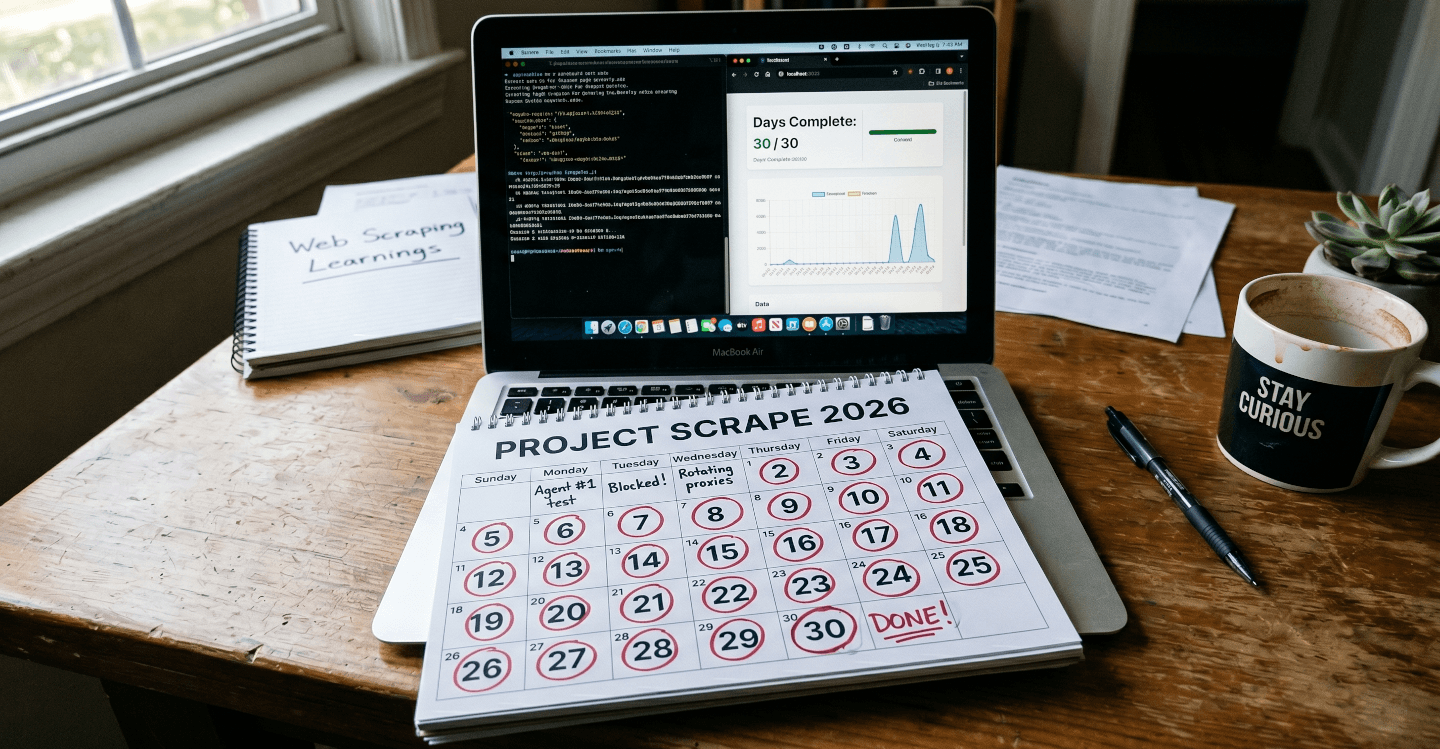
The autonomous web data pipeline is dawning. Going deep on the frontier’s state of the art surprised me, humbled me, and changed how I work.
The industry is abuzz with talk about autonomous web data-gathering agents. But what’s the reality?
For the last 30 days, I did one thing almost exclusively: I built scraping systems with AI agents, from the ground up, across real targets, with real deadlines. Not prototypes designed to impress in a demo, not isolated experiments running against a toy website, but production-grade pipelines that needed to ship and keep running.
I went in with genuine curiosity and came out with something more useful than a hot take: a messy, hard-won picture of where agents genuinely changed my work, where they burned my time, and what I had to unlearn about how I thought development with AI would feel.
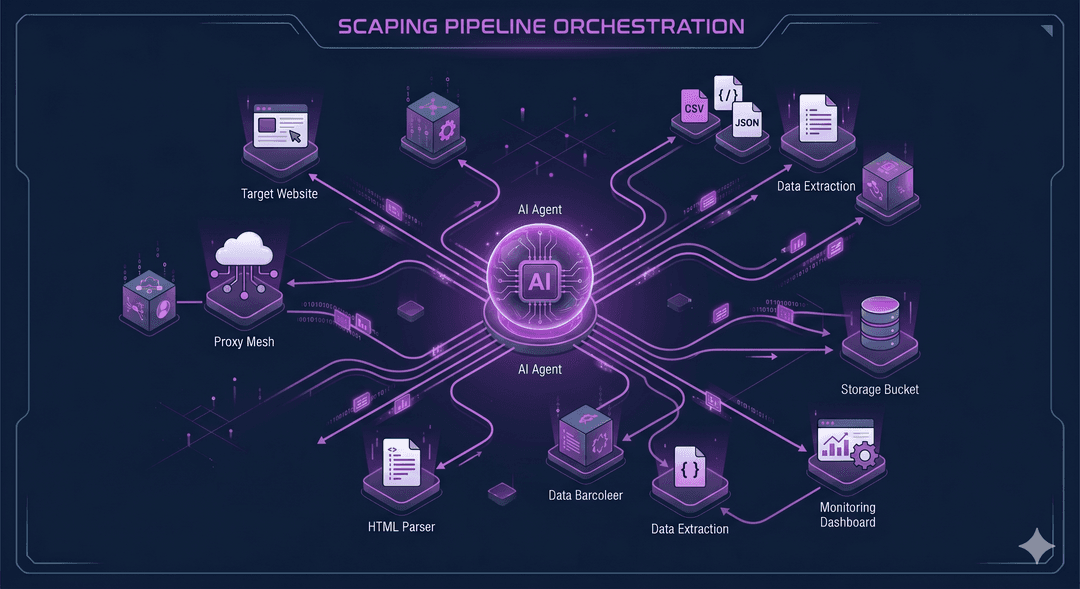
The biggest surprise: Agents really can build pipelines
I did not go into this expecting agents to handle the full build cycle. My assumption, going in, was that they would be useful for the boring middle parts: generating boilerplate, suggesting selectors, maybe scaffolding a spider I would then finish myself.
What I found instead was that, with the right tools and domain-specific context in place, an agent could take a target URL and produce a working, tested pipeline without me writing the bulk of the code. Not just a rough scaffold that got me 60% of the way there - a working pipeline, with selectors, page objects, item definitions, and a passing test suite.
The first time this happened cleanly I actually went back and I checked the output, because I did not quite believe it. The spider ran, the items validated, and the tests passed.
I had been expecting to spend the entire afternoon on it, but it took 45 minutes, and most of that was me reviewing the output rather than the agent producing it. That shift, from writing to reviewing, is the one I keep coming back to when I think about what actually changed over these 30 days.
The caveat I discovered quickly, though, is that the words "right tools" are doing enormous work in that sentence.
The first few sessions where I pointed a general-purpose agent at a blank project and a URL were humbling, with hallucinated selectors, invented conventions, and code that looked plausible - until it completely fell apart on real pages.
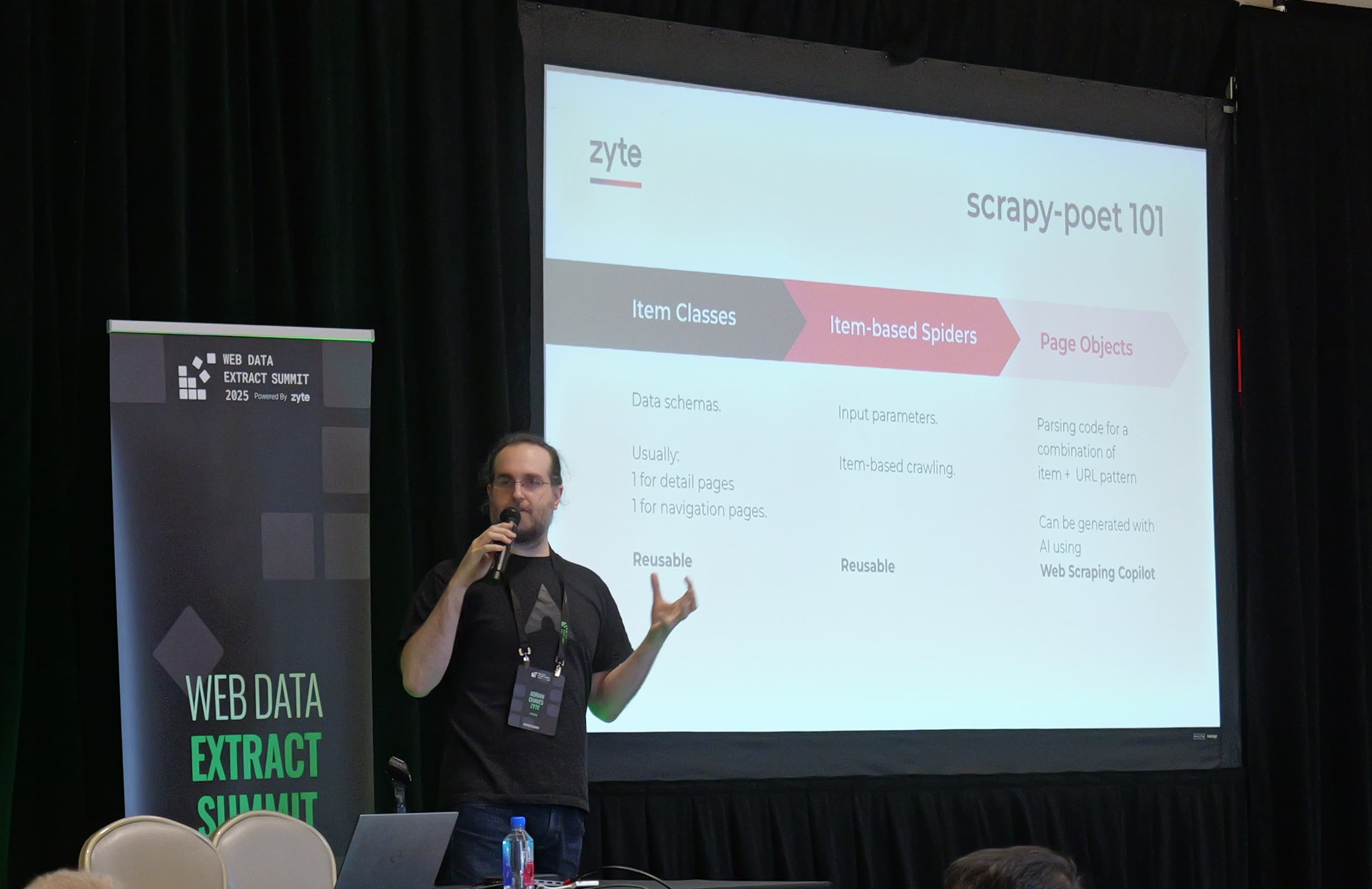
It was only once I built out the proper scaffolding around the agent, a structured project to conform to, Zyte-specific skills and tooling, and well-defined context about how we build at Zyte, that the results became something I could trust.
Zyte's own research into what makes agents succeed or fail at web scraping tracks closely with what I experienced: specialized tooling and context engineering are what separate useful agents from expensive chaos.
The biggest time sink: Tool design
I did not anticipate that the biggest investment of the 30 days would be in building tools rather than in prompting or orchestration, but that is exactly what happened.
I ended up constructing a set of CLI wrappers around my most-used services - primarily Zyte API and related infrastructure - because the raw responses were not shaped for an agent to reason with efficiently, and I kept watching agents get confused by the volume and structure of what came back.
Each tool I built was designed so that the data coming back to the agent was precisely what it needed for the task and nothing else: no raw HTML dumps, no verbose JSON payloads with 40 fields when three were relevant, no response structures that required the agent to do significant parsing just to understand what it had received.
The difference this made was not subtle. Before those tools, I was watching agents latch onto the wrong signal and carry that error confidently through the rest of their work. After, the reasoning was noticeably cleaner and the output was dramatically more reliable.
What I came to understand is that the bottleneck was never the model, it was the quality of the interface between the agent and its tools, and I had been underinvesting in that interface completely. The work of building good tools felt like plumbing at the time, but, looking back, it was the most valuable engineering I did across the entire 30 days.
1# One of my CLI wrappers — the agent gets exactly what it needs, nothing else
2zyte-fetch --url "https://example.com/products" --extract product --fields "name,price,sku"
3# Returns clean JSON with exactly three fields, not 300The mistake I made on day four that I am still thinking about
Around day four, an agent built a working spider in under 10 minutes and I shipped it without setting up the review loop I had been meaning to establish.
The spider ran cleanly, the logs looked fine, and I moved on to the next thing. Three hours later, I had 400 ingested records where the price field was either missing or formatted as a raw string with the currency symbol still attached.
It was all because I had not defined what a valid item actually looked like. The agent had made assumptions that were reasonable given what it had to work with, but wrong.
That experience reframed something for me. I had been thinking of good project structure as a professional habit, something worth doing but not load-bearing in the way that, say, a working selector is. What I discovered is that, when an agent is generating and modifying code on your behalf, your project structure becomes the contract the agent conforms tol; gaps in that contract become gaps in the output. The agent will not fill them with good judgment; it will fill them with plausible guesses.
After day four, I started treating typed item definitions, schema validation, fixture-based tests, and clear module boundaries as prerequisites rather than nice-to-haves, and the reliability of the agent's output improved noticeably as a result. Not because the agent got smarter, but because it had less room to go wrong.
1# What my page objects ended up looking like after I tightened the schema contracts
2
3from web_poet import WebPage, Returns, field
4from scrapy_poet import handle_urls
5from zyte_common_items import Product
6
7
8@handle_urls("example.co.uk")
9class ProductPage(WebPage, Returns[Product]):
10
11    @field
12    def name(self) -> str:
13        return self.css("h1::text").get()
14
15    @field
16    def price(self) -> str:
17        return self.css(".price::text").get()
18
19    @field
20    def sku(self) -> str:
21 return self.css("[data-sku]::attr(data-sku)").get()The speed is real, and I had to learn not to trust it blindly
By week two I was consistently going from a target domain to a deployed, running spider in under an hour on familiar site patterns, which is a compression of my previous workflow that I still find slightly disorienting to think about. The velocity is genuinely there, and I do not want to understate it.
What I had to learn, more slowly than I would like to admit, is that the speed applies uniformly regardless of output quality. An agent does not slow down when the extraction logic it has produced is brittle, does not flag that it is making assumptions about a selector pattern it has only seen once, and does not hesitate when the approach it is taking will break the moment the target site makes a minor update. It ships at full speed no matter what, which means the pressure to slow down and check has to come entirely from you.
The adjustment I eventually made was to stop treating agent sessions like batch processes I could kick off and return to, and to start treating them more like working alongside a very fast colleague who needed regular check-ins. Short cycles, deliberate review points, and a habit of actually reading the output before deploying it. That felt slower in the moment. Looking back at the pipelines I shipped with that approach versus the ones I did not, it was not.
Why I stopped thinking of human-in-the-loop as a limitation
My initial instinct was to treat the moments where I had to step in and verify something as signs that the agent was not good enough yet, as temporary friction that would disappear as the tooling matured. I do not think that anymore.
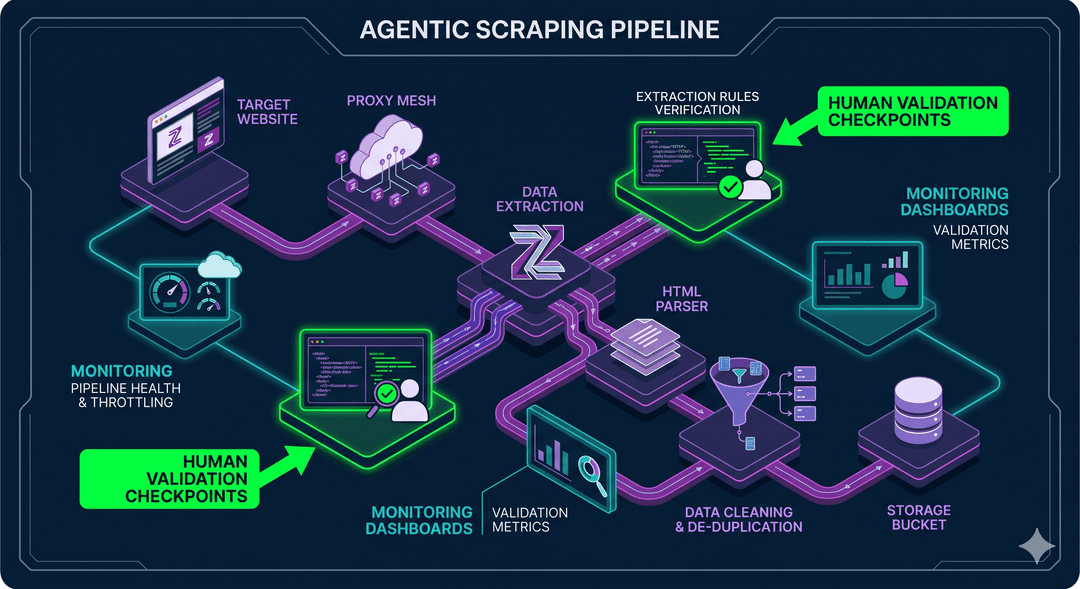
Over the 30 days I set up explicit checkpoints in my agent workflows where the agent would surface what it had done, what it was about to do, and where it had uncertainty, and I would review before it proceeded. Setting those up felt like admitting defeat at first. What I actually found was that they caught a meaningful number of decisions I would have made differently, and that the pipelines built with those checkpoints were more reliable and easier to debug than the ones I had let run freely. The checkpoints were not a workaround for agent limitations. They were part of the system design, and removing them would have made the system worse.
I built lightweight observability into every pipeline I shipped as well: item counts per run, field completeness rates, schema validation pass rates, and error ratios. Without those signals I found I genuinely could not tell the difference between a healthy run and one that was quietly degrading, and that gap between "it ran" and "it worked" is exactly where the expensive surprises live. The Web Scraping Copilot is built around the same idea, keeping AI-assisted development fast while keeping the developer in a position to actually know what is happening.
The moment that genuinely impressed me, and the one that humbled me
The most impressive thing I saw over the 30 days was an agent diagnosing and repairing a broken spider after a target site updated its markup, without me touching a line of code.
The site had changed its product card structure, the extraction started failing, the agent detected the failures, inspected the new HTML, identified where the selectors had drifted, updated the page object, ran the tests against a new fixture, and confirmed the fix. The whole loop took a few minutes. I watched it happen in the logs.
For that class of problem, layout drift and minor structural changes, I came away genuinely convinced that agents are already good enough to handle maintenance work I used to dread.
The ability to detect and repair that kind of breakage automatically is one of the clearest wins I found across the whole 30 days.
The humbling counterpart came when I hit a target with unusual banning behavior. The agent could see that requests were failing but had no reliable way to diagnose why or adapt its approach in a way that actually worked.
That required me to dig into how Zyte API's unblocking was interacting with the site's specific defenses, and it required the kind of accumulated domain knowledge that does not live in a model. The Zyte post on why AI agents struggle with web scraping maps this ceiling out clearly if you want to understand the mechanics of why access problems are so much harder for agents than structural ones. My experience matched what they describe almost exactly.
What I actually do differently now
After 30 days, the honest version of what changed is not a framework for when to use agents. It is a set of instincts I did not have before.
- I now reach for an agent immediately when I am starting something new on an unfamiliar domain, because the exploration work that used to eat half my day happens in minutes.
- But I do not reach for one when I am working on a target with unusual access patterns, because I have learned that the agent will spin confidently and expensively without making real progress.
- I invest time in tool design before I invest time in prompting, because the tool design pays dividends across every session that follows while the prompting only helps the one in front of me.
- And I treat every agent session as collaborative rather than delegative, staying in the loop rather than handing off and walking away.
The 30 days did not resolve the question of whether agents are the future of scraping development, because I do not think that question has a clean answer yet. What they gave me is a much clearer sense of where they already earn their place in the workflow, which is more useful than a verdict.
For a sense of where this is all heading at a systems level, Zyte's piece on the dawn of the autonomous data pipeline is worth reading - the modular, agent-driven architectures they describe feel like a natural extension of what I was building toward by the end of the month, even if I was not thinking about it in those terms at the time.
Want to try Zyte API for free?
start here