Fashion is an industry built on humans being seen. But, when you look beneath the surface of fashion websites, you may see a counterintuitive picture.
Fashion sites are the most difficult of any industry for a machine to read, according to Zyte’s State of Web Access 2026 research.
The average apparel or fashion site scores 2.86 out of five on Zyte’s access complexity scale (rounded up to three in the below heatmap), ahead of banking - ahead of gambling, ahead of every other part of the retail economy.
Within Zyte’s Retail & E-commerce group, fashion tops all eighteen sub-sectors for access complexity, ahead of consumer electronics, furniture and the big general marketplaces.
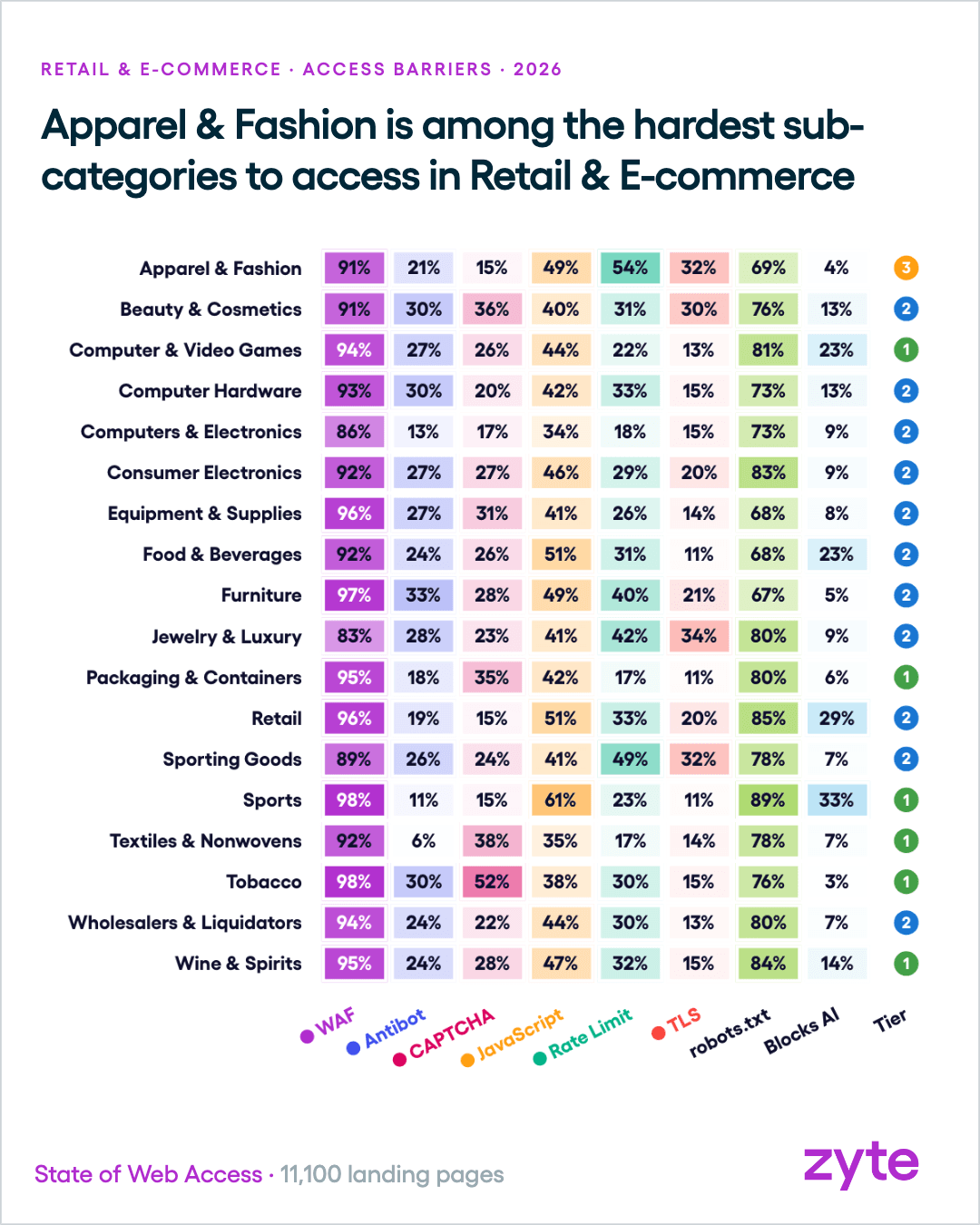
A product page on a typical fashion site could take a full browser, higher-tier infrastructure, and tooling that can cope with a rate limiter that starts counting from the first request.
Such defenses are selective, letting the customer and the search crawler through while raising the cost of large-scale automated collection of the pricing and inventory data that a competitor might want.
Why are fashion websites so hard to scrape?
The controls fashion favors point straight at that goal.
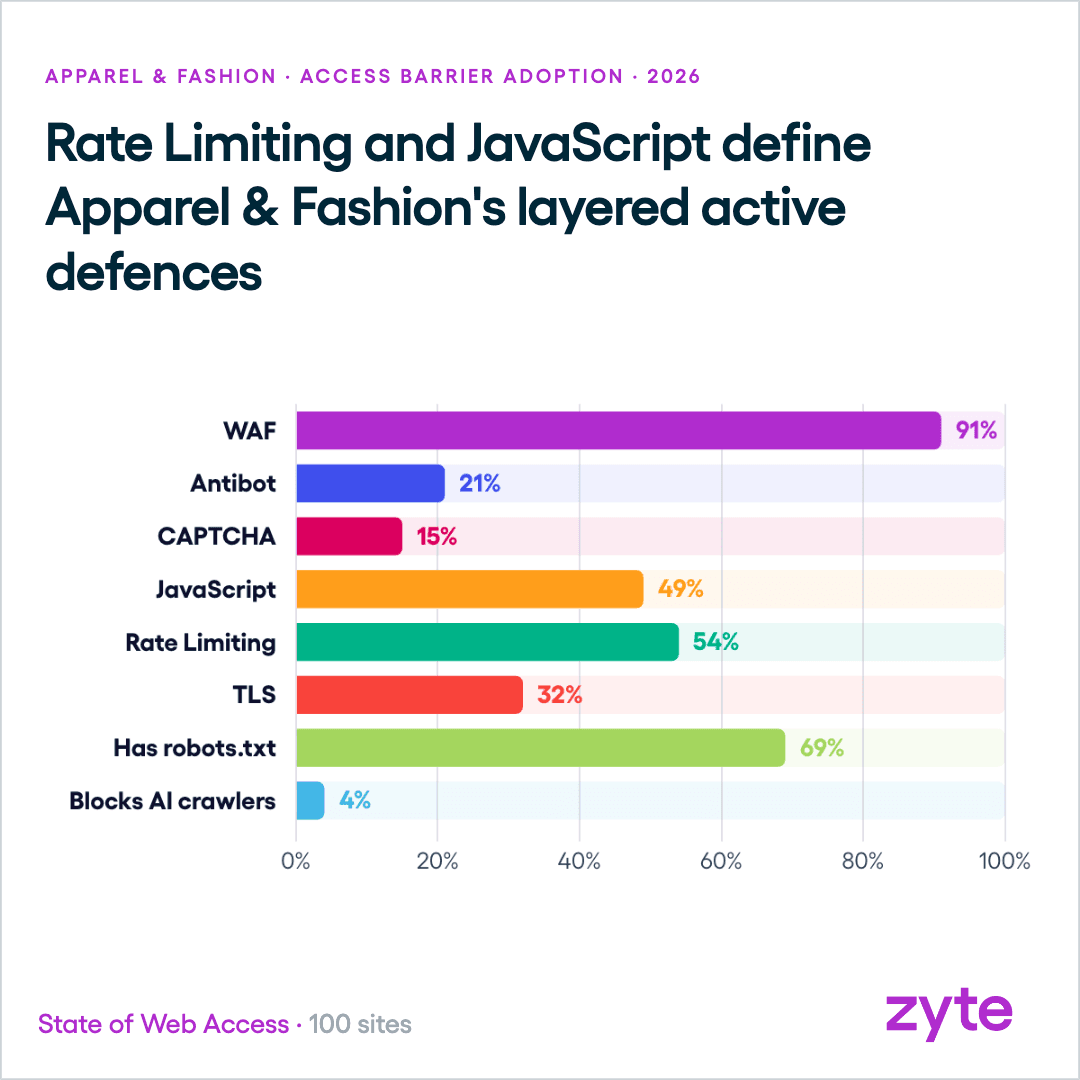
Rate limiting runs on 54% of fashion sites, the highest figure of any industry in the study.
JavaScript rendering is required on 49%.
TLS fingerprinting, which screens clients at the moment they connect, sits at 32%, beaten only by jewelry and luxury.
A web application firewall runs on 91%, though most of those arrive bundled with a CDN and do little on their own.
But the controls fashion avoids are just as telling. CAPTCHA appears on only 15% of sites, below the cross-industry average. That restraint is deliberate: a CAPTCHA in the checkout flow costs sales, and fashion wants to reduce point-of-sale friction.
The industry has moved its defenses to the places a shopper never encounters: the connection, the request rate, the traffic pattern. Barriers are presented to automated collection while the customer notices nothing.
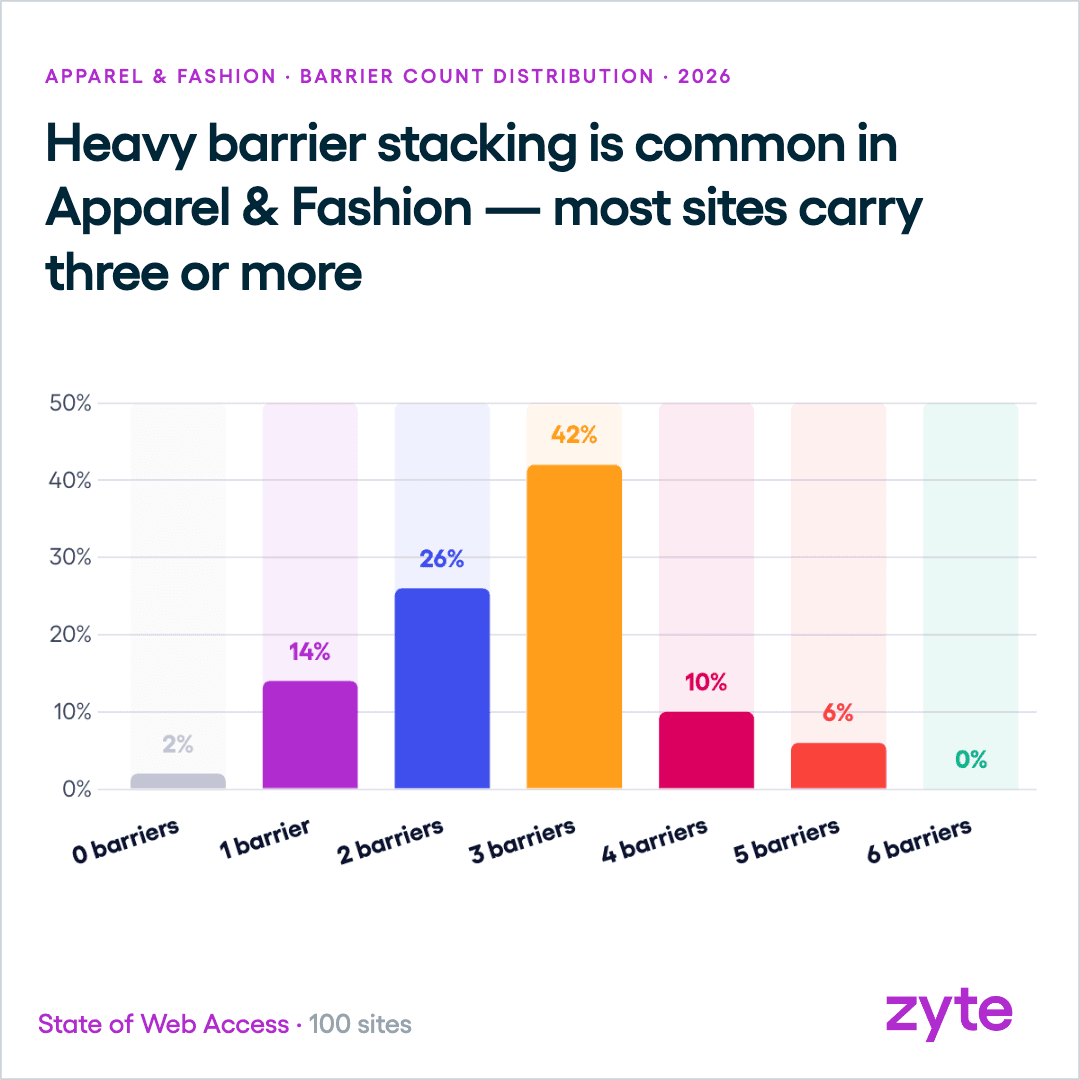
Most fashion sites run three or more barriers at once
Fashion also rarely stops at one access barrier. Most sites layer three or more, and those controls sit at different levels: the connection, the request rate, the rendering, the behavioral signals.
Reaching a fashion site reliably means handling all of them together rather than clearing one and moving on. Any single control is minor, but taken together they turn a quick fetch into sustained engineering work, and that is what drives the sector up the complexity scale.
What does it cost to scrape a fashion site?
Zyte API’s pricing charges for the difficulty a site actually presents rather than a flat rate, meaning customers always pay the lowest rate required.
Zyte API’s complexity tier encapsulates that by classifying every site one to five for complexity and, accordingly, cost.
The most common single outcome for fashion data gatherers is still Easy, which covers a good third of fashion sites.
But the weight of the distribution sits higher up. More than half of fashion sites land at Moderate or above, and better than one in four reach Complex or Advanced, the tiers that call for residential proxies and heavier infrastructure.
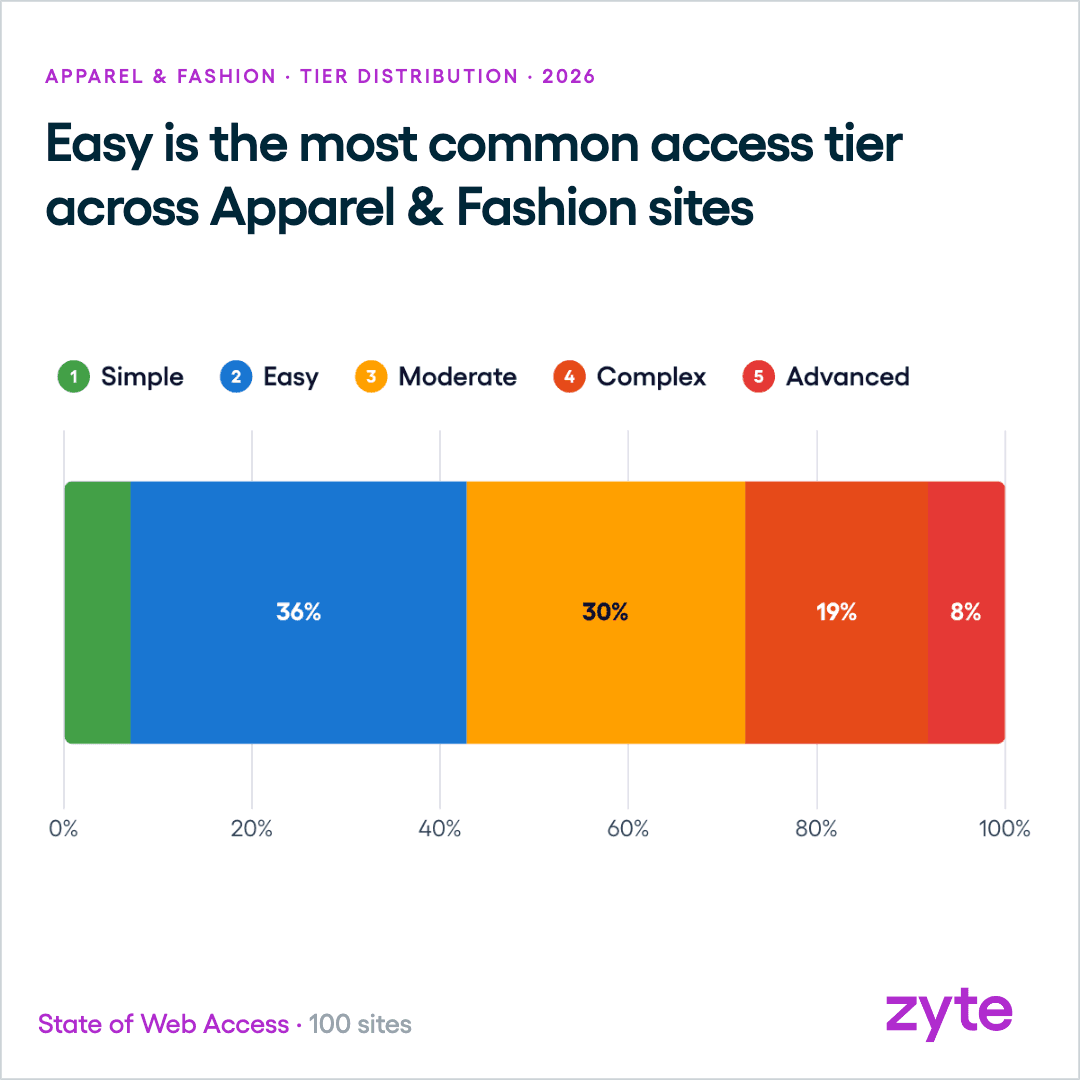
Set against a research-wide average of 1.58, a sector mean of 2.86 in fashion is a wide gap, the difference between fetching a page and running a browser system.
But that average also hides a split in style within the industry:
At the premium and heritage fashion end, the defenses tend to be quiet: an enterprise bot-management platform working in the background, no CAPTCHA to interrupt the shopper, and a block returned on the very first request rather than a polite request to slow down.
A smaller, harder-edged group goes further and puts a visible challenge in front of every visitor.
The high-volume fast-fashion players, whose model runs on turnover, generally run lighter, leaning on basic rate limiting rather than a full bot-management stack.
The pattern follows the commercial logic: the closer a brand sits to scarcity and price protection, the heavier and quieter its controls.
Why fashion guards its pricing data so closely
What stands out about fashion is less the height of its walls than the reason behind them. This is one of the most data-driven industries in retail and e-commerce - it protects its own information precisely because it understands what commercial data is worth.
Fast fashion looks for signals
Fast fashion is the sharpest example. The category was built on reading demand quickly: what is selling, at what price, in what color. It turns small batches around within a fortnight, its leaders running supply chains that respond to the shop floor almost daily.
Watching publicly listed competitor prices has been standard retail practice for years, and an industry that lives on market signals of exactly this kind understands how valuable its own prices, ranges and stock levels are to everyone else. It builds its access controls to match.
Slowing down scalpers
The most demanding corner of this sector is the product drop. Limited sneaker and streetwear releases have turned bot defense into a discipline of its own.
When a shoe sells out in seconds and resells for several times its price on the aftermarket, a release page often draws automated buyers at scale. The big sportswear brands have spent years building queues, waiting rooms and behavioral detection to hold those buyers back. Much of the heavy machinery now common across fashion was proven first in that setting.
Fashion barely blocks AI crawlers
One figure cuts against the current mood. For all the noise about AI and content, fashion barely engages with it - at least, by name.
Only 4% of fashion sites name an AI crawler to block in their robots.txt, a fraction of the rate found in news or publishing.
Around 69% of fashion sites publish a robots.txt at all, and where they do name agents, most of the attention still goes to search crawlers such as Googlebot rather than GPTBot and its peers.
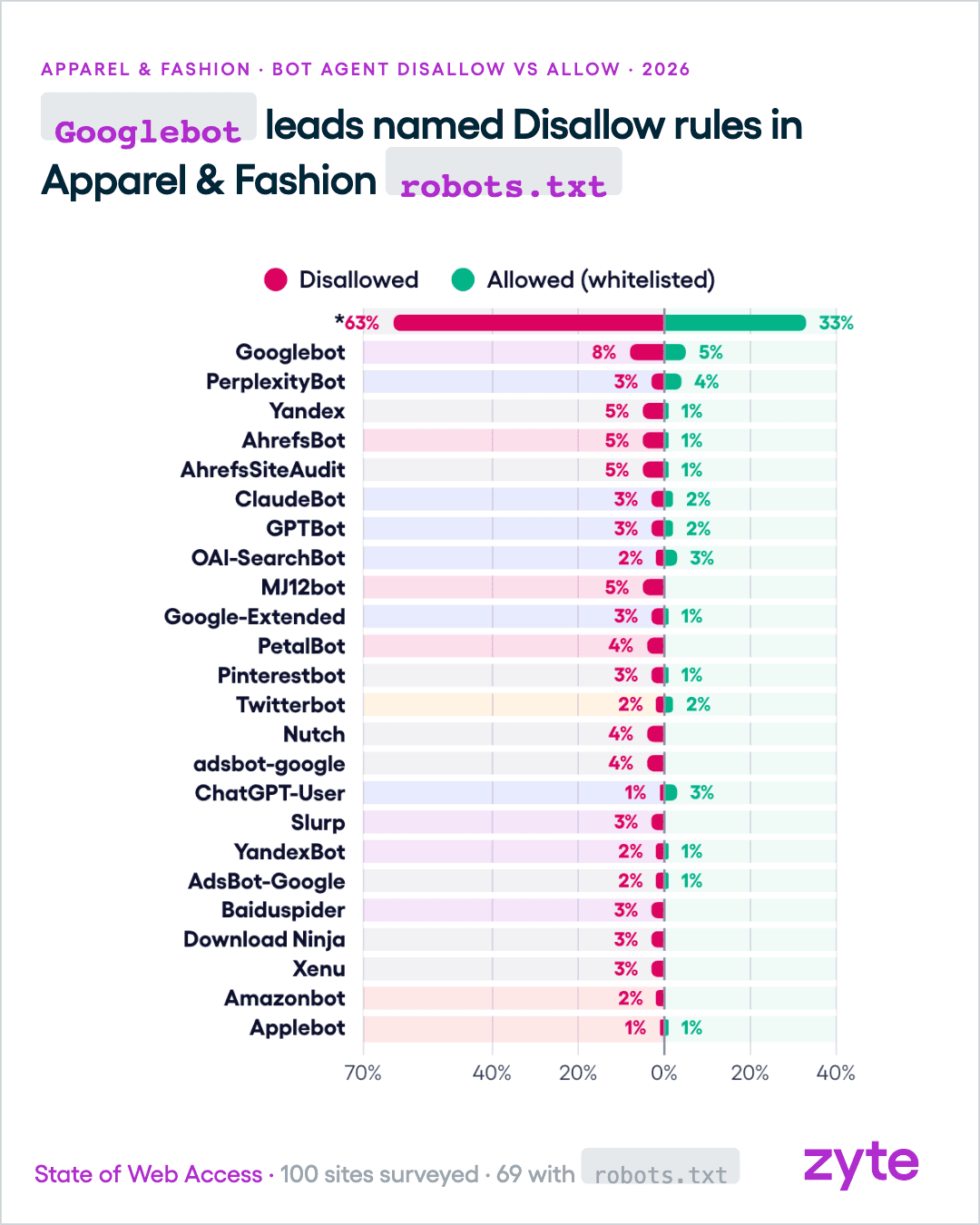
The gap shows where fashion’s concern actually lies. A newspaper worries about a model trained on its archive, but a fashion retailer is largely indifferent to whether a chatbot has read its About page, because its attention is on commercial data.
What this means if you work with fashion data
For anyone scraping fashion data at scale, our research is clear:
Full access is required from the very first request.
The rate limiting responds to client identity rather than speed, so slowing down will not help.
The flagship brands are the ones running the full stack, so budget for the higher tiers on the sites that matter most.
Treat a quiet robots.txt with care: the absence of AI rules says nothing about how heavily a site invests in protecting its commercial data.
Fashion is the hardest sector on the web to reach at scale, and it earned the ranking.
Key takeaways: Fashion access, in five numbers
No other part of e-commerce is harder to access at scale:
2.86 of 5 - the mean access-complexity tier, the highest of any industry Zyte measured.
54% of fashion sites run rate limiting, more than any other sector.
15% use CAPTCHA, below the cross-industry average and kept clear of the checkout.
4% block AI crawlers, so the walls are built for price scrapers, not AI.
Over half of all fashion sites rate Moderate or harder to reach.