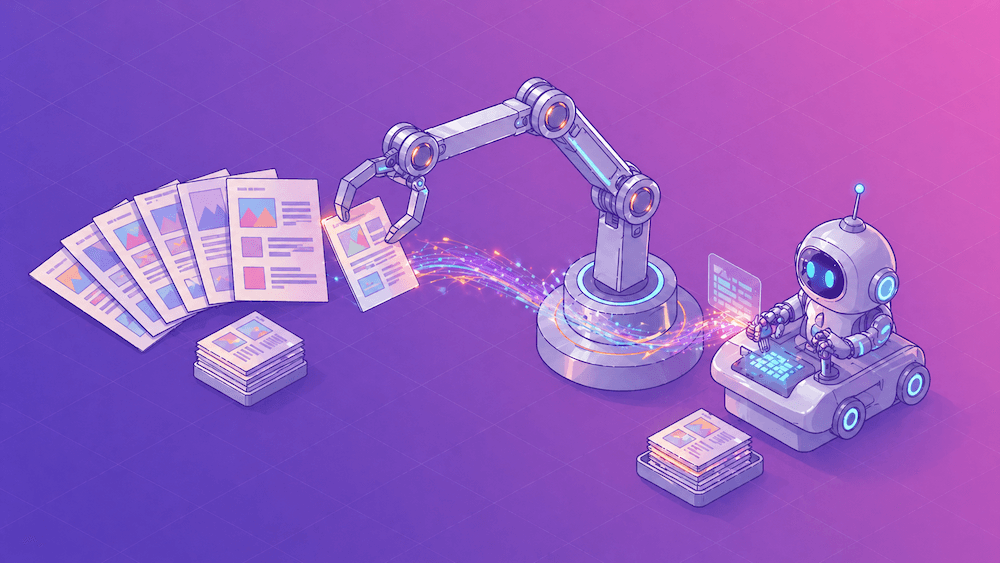
In 2026, web scraping is evolving from AI-assisted efficiencies for individual parts of the process, to autonomy for entire web data pipelines.
End-to-end automation will become the default trajectory for web data pipelines, as agentic scraping shows its potential as an autonomous loop that keeps data deliveries healthy, while humans specify goals, design technical constraints, and define acceptable risks.
Deloitte's 2025 Emerging Technology Trends study found that, while 30% of organizations are exploring agentic approaches and 38% are piloting, only 11% have production deployments. This gap will narrow substantially through 2026. The autonomous agents market is forecast to grow from $4.35 billion in 2025 to $103.28 billion by 2034, with agentic AI expanding at a 44.6% compound annual growth rate.
Picture the new scraping workflow:
- A data team specifies an outcome - a dataset with a schema, coverage targets, freshness, and failure tolerance.
- An AI agent explores the site, discovers what actions are necessary to locate the data, and chooses the cheapest reliable method to fetch it: direct requests where possible, browser interaction where necessary.
In scraping, agents will discover convenient existing website APIs, isolate the relevant endpoints, and propose an efficient extraction plan. When the site changes, the agent won’t simply fail; it will diagnose breakage, regenerate code, re-validate outputs, and escalate only when confidence drops below a threshold.
Key developments
Over the past year, tool-building for AI agents has accelerated across the software landscape, and web scraping is following the same trajectory. Agents can now treat the entire scraping stack as a toolbox - browser execution, Document Object Models (DOM) analysis, and the team’s own data validation codebase.
In practice, agentic scraping will be more robust as a multi-agent system than a monolith - not a single scraping agent, but a team of specialist agents under an orchestrator. As specialized agents proliferate, teams will combine them into a coordinated architecture where each agent does one job well, while a reasoning supervisor agent routes work, maintains state, and enforces guardrails across the workflow.
API discovery agents – Agentic “API self-discovery” is rising as a general development paradigm, and scraping benefits disproportionately: once an agent identifies the right endpoints, it can swap brittle UI automation for stable API pulls. We are seeing tools built to capture network traffic and catalog API calls automatically – exactly the substrate an agent needs to move from “browse” to “extract.”
Schema-first extraction agents – As research like PARSE (EMNLP Industry 2025) makes clear, LLM-driven schema optimization can make entity extraction more dependable.
Self-healing testing agents – The testing world demonstrates the pattern through self-healing browser automation tests that adapt to UI changes by using model reasoning over current application state, preventing unpredictable breakage from stopping data collection.
Vision-based computer-use agents – Models like Google’s Gemini “computer use” can “see”, click, type, scroll, and navigate independently, which makes them effective for unfamiliar, UI-heavy flows and long-tail interfaces with no usable API.
DOM-native browser agents – Instead of “pixels first,” browser agents operate on browser primitives like DOM, network events, and local storages. This approach is typically cheaper and offers more consistent results than computer-use agents.
Coding agents – Because code is the connective tissue of any data pipeline, coding agents are poised to become the backbone of agentic scraping. Early signals are already visible in the emergence of scraping-specific assistants built around scraping-specific patterns and pulling different pieces of the workflow together. What’s making this possible is enhancements to general-purpose language models, which now reign across different major coding benchmarks.
Implications
Workflows become modular and context-aware. Rather than monolithic scrapers, systems will comprise specialized agents such as CAPTCHA handlers, behavioral intelligence, DOM analyzers, and session managers. Pipelines will adapt dynamically - for example, falling back from rendering to simple fetches, switching extraction methods based on page structure, or retrying with alternative access patterns. Context will flow between components, enabling intelligent decision-making across the workflow.
Specialized agents take on larger, end-to-end roles in production scraping. Scraping-specific agents will handle larger portions of the increasingly modular workflow, combining tasks such as discovery, code generation, validation, and iteration into more autonomous units of work. While general-purpose models are rapidly improving, production scraping continues to benefit from domain-specific tooling, context, and guardrails rather than raw model capability alone.
The human role in agentic scraping shifts from implementation to supervision and accountability. Rather than writing selectors and retry logic, engineers will instruct, evaluate, and monitor the agentic systems. This shift reflects a broader change in how technical work is organized around AI systems. Ownership shifts from “who wrote the scraper” to “who owns the data product,” with clearer SLAs, auditability, and decision logs for what the system did and why.
More automation increases website pressure and fragmentation. As autonomous agents proliferate, sites have stronger incentive to harden interfaces, gate access, and formalize automation lanes, reinforcing the macro forces behind escalating anti-bot dynamics and giving rise to the fragmentation of the web.
Recommendations
Apply agents selectively. Not all scraping tasks will warrant agentic approaches. Agentic approaches are not a default for every scrape. For sources that are straightforward and stable, a conventional scraping setup will remain the most cost-effective option.
Match agent types to the job. Combine approaches based on best fit and tool maturity. For example, computer-use agents are best suited for site exploration and complex interactions where probabilistic behavior is acceptable. Reserve code-generation systems for high-volume, repeatable extraction where deterministic output and cost predictability matter.
Build supervision capabilities. Establish tools for evaluating agent performance, enforcing schema constraints, and implementing feedback loops. Human oversight should shift from code generation to output validation and system guidance.
Pilot agents in bounded roles with explicit success criteria. Deploy agent capabilities first where they are easiest to evaluate and safest to contain: site exploration, endpoint discovery, schema mapping, and test generation. Treat “self-healing” as a phased rollout. Start with agent-proposed fixes that require approval, then move to limited autonomous fixes in low-risk segments once the evaluation harness consistently catches regressions.
Iterate toward agent-native workflows. Organizations succeeding with agentic scraping will typically start by integrating agents into existing workflows, then progressively evolve toward more agent-native designs as confidence, tooling, and reliability improve. This requires rethinking task structure, context provision, and output validation. The technology matters, but process redesign is equally critical.