PINGDOM_CHECK

Spiders Activity Graphs

Spiders Activity Graphs - Visualize your spiders' performance with activity graphs. Optimize your web scraping process with actionable insights.

Pablo Hoffman

2 min read ·

Spiders Activity Graphs

Spiders activity graphs

Today we are introducing a new feature called Spider activity graphs. These allow you to visualize quickly how your spiders are working, and it's a very useful tool for busy projects to find out which spiders are not working as expected.

This new graph shows you a snapshot of your project each day, displaying one dot per spider. The best way to illustrate how it works is to look at a particular example. This a snapshot of a single day in a busy project (each dot is a spider running that day):
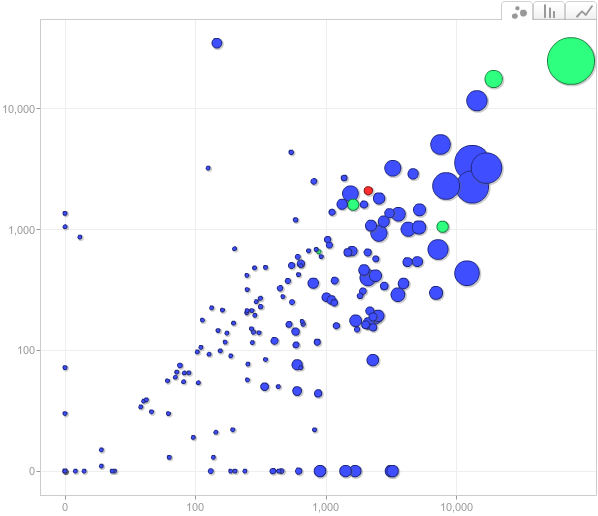
That is just one day, from the last 30 days covered by the graph (which you can quickly traverse).  Here is how the graph is read:

  • each dot is a spider
  • the X axis is how many pages the spider crawled
  • the Y axis is how many items the spider scraped
  • the color is how many jobs of that spider run
  • the diameter is how long the spider take to run

Once we learn how to read it, we can get a sense of the following things by quickly glancing over the graph:

  • how many spiders were running that day
  • which spiders take the most time to run (the largest dots) - you can see spider names by hovering the mouse over the dots
  • which spiders are more (and less) efficient in terms of items/pages ratio
  • which spiders are broken, and how badly. For example, we can quickly realise all dots in the the bottom are spiders scraping zero items and, the further to the right they are, the worse (because they scrape more pages and take more time, without scraping any item). This allows us to quickly identify and disable poorly behaving spiders, to save resources, until we get a chance to fix them.
  • which spiders were under development that day, because those spiders are typically run more often than the ones in production. The red and green dots there indicate those spiders.
  • which spiders are feed-based (the dots on the left) because they fetch a single page (the feed url) and return a lot of items. API-based spiders also tend to have high items/pages ratios.

As you can see, this graph concentrates a lot of information into a single place, which allows to quickly grasp an idea of how the spiders are working and how they compare against each other.

There are other useful features not mentioned here, like being able to track a specific spider (or group of them), changing how metrics are displayed (for example, mapping colors to errors instead of job counts), and playing an automated animation over time. Our customers can already enjoy this new report in the panel, by going to Reports -> Spiders activity.

These are some of the features you can expect from our platform, and it covers both the Scrapy Cloud and Autoscraping services. We believe visualization plays an important role when monitoring and keeping track of many spiders, even if you are lucky enough to have time to dive into detailed reports and lots of numbers (most of us aren't).

Try Zyte API

Build your first scraper in minutes

Free trial, no credit card. From a single request to production in an afternoon.

Get started

Continue reading

The harness matters more than the model - Podcast EP07
AI-assisted data extraction

The harness matters more than the model - Podcast EP07

"The model is the engine — but the harness is everything else." In Episode 7, we dig into why the infrastructure layer around your AI model matters more than the model itself, rank the best models available right now, and ask whether the open-weighted revolution is about to make frontier subscriptions obsolete.

John Rooney11 min read
How to build your first Scrapy extension
Developer interest

How to build your first Scrapy extension

My Scrapy project now plays a triumphant fanfare when a crawl finishes clean and a sad trombone when it doesn't, which is also how I finally learned what Scrapy's extension points are actually for.

Ayan Pahwa11 min read
Now what exactly is loop engineering? And where do Anthropic's Fable 5 model and web scraping fit in?
Developer interest

Now what exactly is loop engineering? And where do Anthropic's Fable 5 model and web scraping fit in?

A viral clip from Claude Code's creator put a name to something a lot of us have been circling: loop engineering. Here's why web scraping may be its best-fit domain — and what that means in practice.

Ayan Pahwa12 min read
Automate deployment of your web scraper on VPS with Ubuntu 24.04 cloud-init
Developer interest

Automate deployment of your web scraper on VPS with Ubuntu 24.04 cloud-init

Your VPS is ready, but now you need to work through the same sequence you have run a dozen times before: apt update, apt install python3-pip, pip install scrapy, playwright install chromium, the Chromium dependency list that never installs cleanly on the first try, Redis, possibly Postgres, whatever else this particular project needs.

Ayan Pahwa9 min read
NotAnInterview: “I Have Superpowers Now"
Developer interest

NotAnInterview: “I Have Superpowers Now"

The problem was a project with 12,000 websites to crawl, and there’s no world where you write custom spiders for 12,000 websites, not with a human team and certainly not sustainably. So Javier built a workflow: a set of AI prompts that could analyze a website, figure out its structure, and generate a crawl configuration that a generic spider could then use.

Neha Setia Nagpal9 min read
Flatcar Linux for web scrapers: deploy immutable containers with just one config file
Developer interest

Flatcar Linux for web scrapers: deploy immutable containers with just one config file

The next time you spin up a VPS to give it a persistent home, you spend the better part of an afternoon rebuilding from memory. Here's a tool to help using Flatcar Linux

Ayan Pahwa11 min read

The Community · Newsletter

The best of Zyte and the data web, in your inbox.

One curated edition — new articles, product updates, and the stories shaping the data web. No noise.